
Finding the Best AI Photo Generator for Your Creative Needs
The best AI photo generator really comes down to what you're trying to accomplish. If your goal is to create consistent brand assets and e-commerce visuals, PhotoMaxi is built for that. For pure artistic exploration, Midjourney is in a league of its own. And if you’re a technical user who wants total control, Stable Diffusion is your playground.
Ultimately, your ideal tool hinges on a simple question: do you need commercial reliability or creative freedom?
Which AI Photo Generator Is Right for You
Picking the right AI photo generator isn't about finding one single "best" tool. It’s about matching the platform to your specific purpose. The market is full of options, and they all have different strengths. An artist chasing a surreal, stylistic masterpiece has completely different needs than a Shopify merchant who just needs clean, consistent on-model product shots.
This distinction is everything because the tech and user experience from one tool to the next can be worlds apart. Some generators are designed for simplicity and predictable results, while others offer a complex but powerful toolkit for anyone willing to put in the time to learn. Figuring out your primary goal—whether it's creative expression, marketing, or technical experimentation—is the essential first step.
The AI image generator space has grown incredibly fast, jumping from a valuation of USD 418.5 million to a projected USD 2,633.2 million by 2035. That's fueled by a massive compound annual growth rate (CAGR) of 18.2%. This growth shows just how much impact the technology is having everywhere. You can learn more about these market trends and what they mean for creators in this detailed analysis.
High-Level Comparison of Leading AI Photo Generators
To help you sort through the options, here’s a quick overview of some of the top contenders. This table gives you a bird's-eye view, highlighting what each tool does best and who it's really for. Think of it as a starting point before we dive deeper into the specific features and workflows.
| Generator | Best For | Key Differentiator | Commercial License |
|---|---|---|---|
| PhotoMaxi | E-commerce & Brand Consistency | High-fidelity likeness & reusable models | Clear & accessible on paid plans |
| Midjourney | Artistic & Stylized Imagery | Unmatched aesthetic quality & community | Included with paid subscription |
| Stable Diffusion | Customization & Technical Control | Open-source flexibility & fine-tuning | Varies by model; requires diligence |
This high-level comparison makes it clear that the right choice depends entirely on the job at hand. Each tool has its place, and understanding their core strengths is key to making a smart decision.
Key Takeaway: Let the final application guide your choice. For professional work like marketing campaigns or product catalogs where consistency is everything, a specialized tool like PhotoMaxi is the most logical option.
For example, an e-commerce brand needs an AI that can keep the same model's face across dozens of different outfits and scenes. A digital artist, on the other hand, might want a tool that surprises them with unique visual styles every single time. This guide is here to give you a strategic framework to match your needs with the right tech.
What to Look for in an AI Photo Generator
Before you jump into any AI photo generator, you need a solid game plan for evaluating them. It's easy to get wowed by a single, cool-looking image, but for any real work, you need more than that. The best tools have to deliver consistency, fit into your workflow, and give you the legal freedom to actually use what you create.
It's one thing to generate a pretty picture. It's another thing entirely to create an image that accurately captures a specific person, product, or brand character. That’s the real difference between a fun novelty and a serious professional tool. Once you know what to look for, you can pick a generator that doesn't just make eye-catching visuals but becomes a dependable part of your creative or business toolkit.
Likeness Fidelity and Consistency
For anyone using AI for professional reasons, likeness fidelity is the most important thing to get right. This is all about how well the AI can recreate a specific person’s face or a product’s unique details over and over again. If a tool can't nail the likeness, it’s basically useless for creating consistent marketing materials or on-model product shots.
Just as critical is multi-image consistency. Can the generator take the same AI model and realistically place them in different scenes, outfits, and poses while keeping them recognizable? This is where many platforms fall flat. You’ll often see the "same" person looking more like a distant relative from one image to the next. For a brand campaign or an e-commerce catalog, that kind of inconsistency just won't fly.
A generator’s true value for business isn't in creating one perfect image, but in its ability to create hundreds of consistently accurate and on-brand images. This is where specialized tools designed for commercial use cases truly stand apart.
For a little context, this diagram shows the basic process of turning a text prompt into an image—something all these generators do.
How consistently a tool handles this process is what separates the best AI photo generators from the rest, especially when your work depends on it.
Specialized Workflows and Use Cases
A top-tier tool should do more than just spit out random images; it should offer workflows built for specific goals. For e-commerce store owners, this could be a simple, built-in process for generating virtual model try-ons right from their product photos. For marketers, it might be a system for creating a whole month's worth of social media content featuring a consistent brand mascot.
Think about the specific problems you need to solve. Does the platform play nice with the tools you already use, like Shopify? Can you easily save, manage, and reuse the AI models you’ve trained? These practical features are often way more valuable than having access to thousands of artistic styles you’ll never actually touch. To see how AI can be applied in different creative fields, you can find some great insights on the PhotoMaxi blog.
Commercial Licensing and Usage Rights
This last one is the most critical part for any business: commercial licensing. The terms of service on these platforms can be a maze, and not all of them give you clear, straightforward rights to use your generated images for profit. This is a huge legal risk that a lot of people accidentally ignore.
Before you sink any time or money into a platform, read the licensing agreement carefully. Here’s what you need to look for:
- Clear Commercial Use Grant: The terms should spell out that you can use the images for commercial purposes—things like advertising, marketing, and selling products.
- Ownership of Generations: You need to know who owns the images you create. The best platforms will grant you full ownership of your outputs, period.
- Restrictions and Limitations: Pay attention to any forbidden uses. Most platforms have rules against creating defamatory content or violating someone else's copyright.
Choosing a generator with a transparent, business-friendly commercial license isn't optional. It’s what protects your work, your brand, and your business from messy legal problems down the line.
A Head-to-Head Comparison of Top AI Generators
Choosing the right AI photo generator can feel overwhelming. Every tool on the market promises the moon, but the real test isn't about producing one amazing picture; it's about how they perform under the pressure of real-world business needs. So, let's skip the generic feature lists and put the top contenders—PhotoMaxi, Midjourney, DALL-E 3, and Stable Diffusion—to the test in situations that professionals actually face.
This isn't just about cool tech. The AI image generator market is set to explode, projected to grow by USD 2.39 billion between 2025 and 2029 at an eye-watering CAGR of 31.5%. This boom is fueled by practical business applications, with e-commerce already seeing a 30% sales uplift from AI-enhanced visuals. And with the best tools hitting over 90% in photorealism tests, telling them apart requires a closer look. You can dive deeper into these market-driving technologies on Technavio.
Midjourney: The Artistic Powerhouse
There's a good reason Midjourney is the darling of digital artists. Its core strength is creating stunning, highly stylized images that feel like they belong in a gallery or a high-end magazine. If you're looking for conceptual art, powerful editorial illustrations, or anything with a cinematic flair, Midjourney is simply in a league of its own.
Its unique Discord-based workflow also creates a vibrant community where you can learn by seeing what others are creating. The latest version, v6, has made huge leaps in realism, but this artistic freedom comes at a price.
Where Midjourney stumbles is in consistency. Trying to get the exact same character or face to appear across multiple images is a huge headache. It's fantastic for creating a single, breathtaking shot, but it falls apart when you need a set of images featuring the same person, which is a deal-breaker for on-model e-commerce or brand campaigns.
Stable Diffusion: The Flexible Tinkerer
For those who love to get under the hood, Stable Diffusion is the undisputed open-source champion. Its biggest selling point is control. You can run it on your own hardware, tap into a massive ecosystem of community-trained models, and fine-tune every little detail of the image generation process.
This makes it the go-to for technical users and anyone who wants to train a custom model on a specific style or product line. The possibilities are truly endless.
But all that power comes with a steep learning curve. Getting it set up requires some technical skill, and producing consistently great results means wrestling with complex settings and prompts. For a business owner who just needs high-quality images without becoming an AI expert, Stable Diffusion's complexity is a serious hurdle. Commercial licensing can also be a minefield, as it depends entirely on the specific community model you're using.
DALL-E 3: The Seamless Integrator
DALL-E 3 shines because of its brilliant integration with ChatGPT. This makes it incredibly easy for anyone to get started. You can just describe what you want in plain English, and ChatGPT handles the difficult job of writing a detailed prompt for you.
It's fantastic at understanding complex instructions and is perfect for creating clean, illustrative images for things like blog posts, presentations, or social media. Its ability to accurately render text within images is another major advantage.
Key Insight: While DALL-E 3 is a master of interpretation and ease of use, it shares a critical weakness with Midjourney for commercial work: it can’t maintain character consistency. It’s a powerful all-rounder but not the specialist you need for brand-focused projects.
Just like Midjourney, getting the same face to appear repeatedly is next to impossible. This makes it a great tool for brainstorming and one-off content, but it's not built for creating a consistent brand identity or product catalog.
PhotoMaxi: The Commercial Specialist
This is exactly where a purpose-built tool like PhotoMaxi finds its place. It was designed from the ground up to solve the two biggest problems plaguing general-purpose generators: likeness fidelity and multi-image consistency.
PhotoMaxi is for commercial use, plain and simple. For an e-commerce brand, that means you can train a custom AI model on a specific person, then generate hundreds of on-model product shots in different locations, poses, and outfits—all with a perfect likeness. This is something the other tools simply can't do reliably.
Let's look at how these differences play out in a granular feature comparison.
Feature Breakdown of Leading AI Generators
The best way to see the practical differences is to lay out their capabilities side-by-side. The following table breaks down what really matters for professional use, moving beyond just image quality to the features that define a workflow.
| Feature | PhotoMaxi | Midjourney | DALL-E 3 | Stable Diffusion |
|---|---|---|---|---|
| Likeness Fidelity | Excellent: Core feature via custom model training. | Poor: Inconsistent, generates "similar" faces at best. | Poor: Lacks any dedicated consistency features. | Moderate: Possible with LoRA/DreamBooth, but very technical. |
| Model Training | Yes: Simple, user-friendly custom model creation. | No: Cannot train on your own subjects. | No: Uses a general, pre-trained model. | Yes: Highly customizable but requires technical expertise. |
| API Access | Yes: Built for workflow and app integration. | No: No official API is available for developers. | Yes: Available through the OpenAI API. | Yes: Various APIs and open-source options. |
| Use Case Focus | E-commerce, Marketing, On-Model Photography | Artistic & Conceptual Image Creation | General Content & Ideation | Technical Customization & Research |
| Ease of Use | High: Designed for business users. | Moderate: Requires learning Discord commands. | Very High: Simple, conversational interface. | Low: Requires significant technical setup & knowledge. |
| Pricing Structure | Per-image credits with custom model training plans. | Monthly subscriptions with generation limits. | Included with ChatGPT Plus or via API credits. | Free (open-source), but requires hardware/hosting costs. |
This breakdown makes the distinctions crystal clear. While tools like Midjourney and DALL-E 3 are fantastic creative partners, PhotoMaxi is engineered to be a reliable production tool.
To put it another way: for artistic exploration, Midjourney is king. For total technical control, Stable Diffusion is unmatched. But for any business that depends on consistent, repeatable, and on-brand visuals, PhotoMaxi is the specialist built for the job.
Putting AI Generators to Work in the Real World
Knowing the features is one thing, but seeing how these tools actually perform in a day-to-day workflow is what really matters. Let's move past the spec sheets and dig into how professionals can use an AI photo generator to solve real problems and get measurable results.
For a business, particularly in e-commerce or marketing, the goal isn't just one perfect picture. It's about creating a high volume of consistent, on-brand images quickly and without breaking the bank. This is where the specialized tools really start to pull away from the general-purpose ones, turning a creative idea into a repeatable, scalable process.
This visual breakdown gives a quick sense of how the top contenders stack up for professional use, highlighting their core strengths.
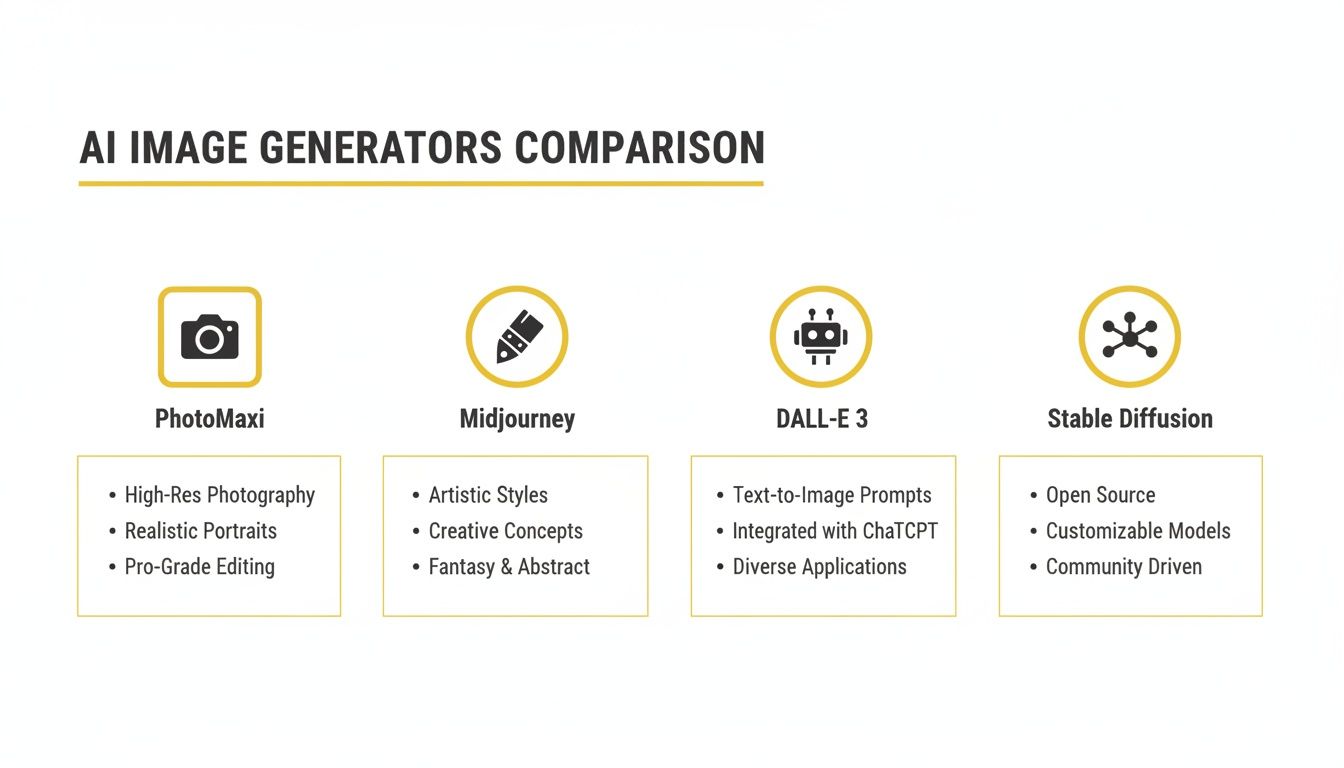
What jumps out immediately is the clear divide between tools built for general creativity and platforms like PhotoMaxi that are designed from the ground up for commercial work.
E-commerce Workflow: From Product Shot to On-Model Showcase
If you've ever run an e-commerce brand, you know the logistical nightmare of traditional photoshoots. Juggling models, photographers, locations, and inventory is expensive and eats up weeks of time. An AI-first workflow sidesteps all of that.
Here’s what that looks like in practice, using a tool like PhotoMaxi that’s built for exactly this scenario:
- Train Your Virtual Model: First, you upload a small set of clear, high-quality photos of a person. The AI learns their specific features and creates a reusable "virtual model" that looks just like them every single time.
- Provide a Product Image: Next, upload a clean shot of your product. This could be a t-shirt on a mannequin or laid out flat.
- Craft a Descriptive Prompt: Now, you just tell the AI what you want. A good prompt combines the model, the product, and the scene. For example:
[Virtual Model Name] wearing the [Product Name] t-shirt, standing in a bright, modern coffee shop, smiling at the camera, soft natural lighting. - Generate and Refine: The AI will generate a batch of images based on your prompt. From there, you can tweak the prompt to adjust poses, expressions, or backgrounds until you have a full gallery of on-model shots for your store.
This entire process can shrink a production timeline from weeks down to just a few hours. Instead of a massive logistical undertaking, a brand can generate hundreds of unique, high-quality product photos with the same recognizable model, locking in brand consistency across an entire catalog.
Marketing Workflow: Developing a Consistent Brand Mascot
Let's switch gears to a marketing team or a content creator. Here, the goal is to create a unique brand mascot and use it consistently across every campaign, from social media to website banners. Consistency is everything for brand recognition.
This is a massive stumbling block for many generators, but platforms with strong character consistency features make it simple.
Maintaining Your Mascot Across Channels
Here’s how you can create and maintain a brand mascot for the long haul:
- Initial Concept Generation: To start, use a generator to brainstorm what your mascot could look like. A broad prompt is perfect here, something like:
Friendly, futuristic robot mascot for a tech company, minimalist design, white and blue colors, cheerful expression. - Establish a "Seed" Character: Once you land on a design you love, you need to lock it in. With PhotoMaxi, you’d do this by training a new model on that initial image, which teaches the AI that character’s specific appearance.
- Deploy Across Scenarios: Now that your mascot’s look is set, you can drop it into any scene with a simple prompt. Think
[Mascot Name] holding a smartphone with our app on the screenor[Mascot Name] celebrating a holiday for a seasonal social media post.
This approach ensures your mascot is instantly recognizable, whether it's in a blog post, an animated video, or a print ad. It solidifies your brand identity and gives customers a memorable character to connect with.
Better yet, you can bring these static assets to life. Many creators are now figuring out how to make AI videos from their images, turning consistent characters into animated content for platforms like TikTok and Instagram. This opens up a whole new world of possibilities for storytelling and brand promotion.
Why PhotoMaxi is Built for Commercial and Brand Use
While many AI tools can generate a stunning, one-off image, commercial work plays by a different set of rules entirely. For brands, e-commerce stores, and professional creators, what really matters is reliability, predictability, and consistency. These are the three areas where most general-purpose generators fall flat, making a specialized tool a necessity, not just a nice-to-have.
This is especially true in the North American market, which makes up over 41% of the global AI image generator market. The demand from e-commerce, media, and advertising is enormous. With the market currently valued at USD 9.10 billion and expected to jump to USD 63.29 billion by 2030, the need for professional, commercially-sound solutions is only getting more urgent. You can dig into the trends driving this growth in this market analysis.
This is precisely the environment PhotoMaxi was designed for. It was built from the ground up to solve the real-world problems businesses face when trying to use AI for images.
Mastering Likeness Fidelity and Consistency
The Achilles' heel of artistic generators like Midjourney is their struggle to reliably reproduce the same face or character. You might get someone who looks similar, but for a brand, "similar" just doesn't cut it. PhotoMaxi's core technology is laser-focused on solving this exact problem.
Its real power comes down to two things:
- High-Fidelity Likeness: You can train a custom model on a specific person, which means the AI learns to replicate their unique facial features perfectly. This isn't about creating a vague look-alike; it’s about generating a true digital twin.
- Multi-Image Consistency: Once that model is trained, you can place it in countless scenarios, outfits, and poses. The likeness stays completely consistent and recognizable across every single image. This is a game-changer for building cohesive marketing campaigns or large product catalogs.
For a business, the ability to generate hundreds of on-model photos that are perfectly consistent is a superpower. It eliminates the cost and logistical chaos of traditional photoshoots while ensuring absolute brand continuity.
This level of control is what separates a professional tool from an experimental one. It shifts the conversation from, "What cool image can I make?" to "How can I reliably produce the exact assets my business needs, every time?"
A Workflow Built for Business
Beyond the technology itself, PhotoMaxi is designed with a commercial workflow in mind. The platform isn't an artist's sandbox; it's a production studio for business users who need to get results quickly and efficiently.
The process is refreshingly straightforward: train your model, write a clear prompt, and generate your assets. This simple approach gets rid of the steep learning curve you'd find with more technical tools, allowing marketers and store owners to get the job done without needing to become AI prompt engineers.
Clear Commercial Licensing and Monetization
Maybe the most important point for any business is that PhotoMaxi offers clear, unambiguous commercial licensing on its paid plans. This is a critical detail that many overlook, but using a platform with murky terms of service can expose your business to huge legal risks.
With PhotoMaxi, you have explicit permission to use your generated images for advertising, product listings, social media, and any other for-profit purpose. That clarity gives you the peace of mind to build your brand’s visual identity on a solid, legally sound foundation. It’s a key reason why, for any serious commercial work, PhotoMaxi stands out as the best AI photo generator for professionals.
Discover how these business-focused features can overhaul your content production by exploring the PhotoMaxi platform.
Your Top Questions About AI Photo Generators Answered
Once you start looking at AI photo generators for serious work, a whole new set of questions comes up. It's less about which one makes the coolest art and more about which one works for a real business. Let's break down the questions I hear most often from professionals trying to make the right choice.
Getting these answers right is key. It helps you pick a tool that not only produces great images but also fits your workflow, budget, and legal needs.
What Is the Most Critical Factor for Business Use?
When you're running a business, it boils down to two things: output consistency and a clear commercial license. Of course, you need good-looking images, but that's just the table stakes. The real game-changer is being able to generate the same person, product, or brand style over and over again.
On top of that, you absolutely need a transparent, no-nonsense commercial license to avoid any legal trouble. This is where professional tools like PhotoMaxi really pull ahead of the more experimental or hobbyist platforms. They're built from the ground up with these business needs in mind.
Can I Legally Use AI Photos for My E-Commerce Store?
Yes, but only if you're using a service that explicitly gives you commercial rights. Most of the big paid platforms, including PhotoMaxi and the paid plans for Midjourney, are clear that you can use what you create for things like product listings and advertising.
The free or research-focused tools are a different story; their terms are often very restrictive. Always, always read the terms of service. Taking five minutes to check the fine print can save you from a massive legal headache later on.
Key Insight: The "best" generator for business isn't just about the prettiest pictures. It's the one that gives you a solid legal foundation to build on, ensuring your creative assets are actually yours to use.
This legal clarity is what allows you to move forward with confidence, knowing the images you create for your brand are safe.
How Can I Maintain Character Consistency Across Images?
This is the million-dollar question and one of the biggest challenges in AI image generation. Getting the same face or character to appear in different scenes is tough, and it’s what separates the pro tools from the basic ones. The most reliable way to do it is with custom model training, a feature at the core of PhotoMaxi. You feed it your own photos, and it learns to replicate that specific person or object with incredible accuracy.
Other methods exist, like using the same "seed" number to get a similar vibe or writing hyper-detailed prompts. But honestly, they're hit-or-miss for getting an exact facial match. For any serious brand work—like on-model photoshoots or a consistent brand mascot—"close enough" just doesn't cut it.
Here’s a quick look at how the different methods compare:
- Custom Model Training (PhotoMaxi): This is the gold standard. It offers the highest fidelity by training the AI on your specific subject.
- Seed Numbers (Midjourney/Stable Diffusion): Good for keeping a consistent style or composition, but it won't reliably reproduce a face.
- Detailed Prompts (All Tools): You can get closer with a very specific prompt, but the AI's interpretation will almost always introduce small, frustrating inconsistencies.
What Ethical Considerations Should I Be Aware Of?
Using this technology responsibly is a big deal. The main things to keep in mind are avoiding the creation of misleading images (like deepfakes), respecting intellectual property (don't try to mimic a living artist's style without their permission), and being transparent when an image is AI-generated, especially in contexts where it might cause confusion.
Most reputable platforms have built-in filters to prevent the creation of harmful or overtly biased content. But at the end of the day, the responsibility is on you, the creator. Staying informed on best practices and platform policies is the best way to use this technology ethically and maintain the trust of your audience.
Ready to create stunning, consistent, and commercially-safe visuals for your brand? PhotoMaxi is the professional's choice for reliable AI photo generation. Start your project today and see the difference.
Related Articles


Ready to Create Amazing AI Photos?
Join thousands of creators using PhotoMaxi to generate stunning AI-powered images and videos.
Get Started Free