
Virtual Try On Technology: Transform Ecommerce with AR & AI

Ever found yourself staring at a product online, wondering, "But how will it actually look on me?" That hesitation is the biggest wall between browsing and buying. Virtual try-on (VTO) technology is the tool that’s tearing down that wall.
Think of it as a magic mirror right on your phone or computer. It closes the gap between the polished look on a professional model and how that same item will fit into your real life.
Your Digital Fitting Room Awaits
At its core, virtual try-on is a powerful set of technologies designed to let you visualize products on yourself without ever leaving home. It’s all about swapping uncertainty for confidence. Instead of guessing, customers get to see for themselves, making the whole shopping experience more personal, fun, and decisive.
This isn't just one single piece of tech. It’s a whole toolbox of different approaches, each with the same goal: bringing a product to life in the customer’s world. Let's break down the main players.
To get a clearer picture, it helps to see how these technologies stack up against each other. Each one offers a different kind of experience and is best suited for specific types of products.
Three Core Types of Virtual Try On Technology
| Technology Type | How It Works | Best For |
|---|---|---|
| Augmented Reality (AR) | Overlays a 3D digital model of a product onto a live video feed from your camera. Your movements are tracked in real-time, making the product appear to be on you. | Cosmetics (lipstick, eyeshadow), eyewear (glasses, sunglasses), accessories (jewelry, watches), and trying on different hair colors. |
| AI Image Generation | Uses advanced AI to realistically place an item of clothing onto a static photo you upload or a stock model with a similar body type. No live camera needed. | Apparel of all kinds (dresses, shirts, pants), where fit and drape on a specific body shape are the most important factors. |
| 3D & 360° Viewing | Renders a detailed 3D model of a product that you can spin, zoom, and inspect from every possible angle. It's less "try-on" and more "try-out." | Footwear, furniture, electronics, and any product where understanding its dimensions, texture, and all-around design is crucial. |
Each of these methods offers a unique way to bridge the online-offline divide, giving shoppers the visual information they've been missing. For creators, exploring how a photorealistic AI image generator works can reveal just how powerful this kind of visualization can be.
Solving the "Will It Fit?" Problem
The fundamental challenge of e-commerce has always been that disconnect. A customer sees a shirt on a size 2 model under perfect studio lights, but has no clue how it will drape on their own body, match their skin tone, or vibe with their personal style. This gap leads to abandoned carts and, even worse, costly returns.
Virtual try-on technology directly addresses this pain point. It’s your personal fitting room, right on the screen.
By turning a flat, 2D product photo into a personalized, 3D experience, VTO gives customers the visual proof they need to click "Add to Cart" without a second thought. It’s not a gimmick; it’s essential decision-making data.
This concept map breaks down how this "magic mirror" works, combining AR and AI to deliver that all-important shopper certainty.
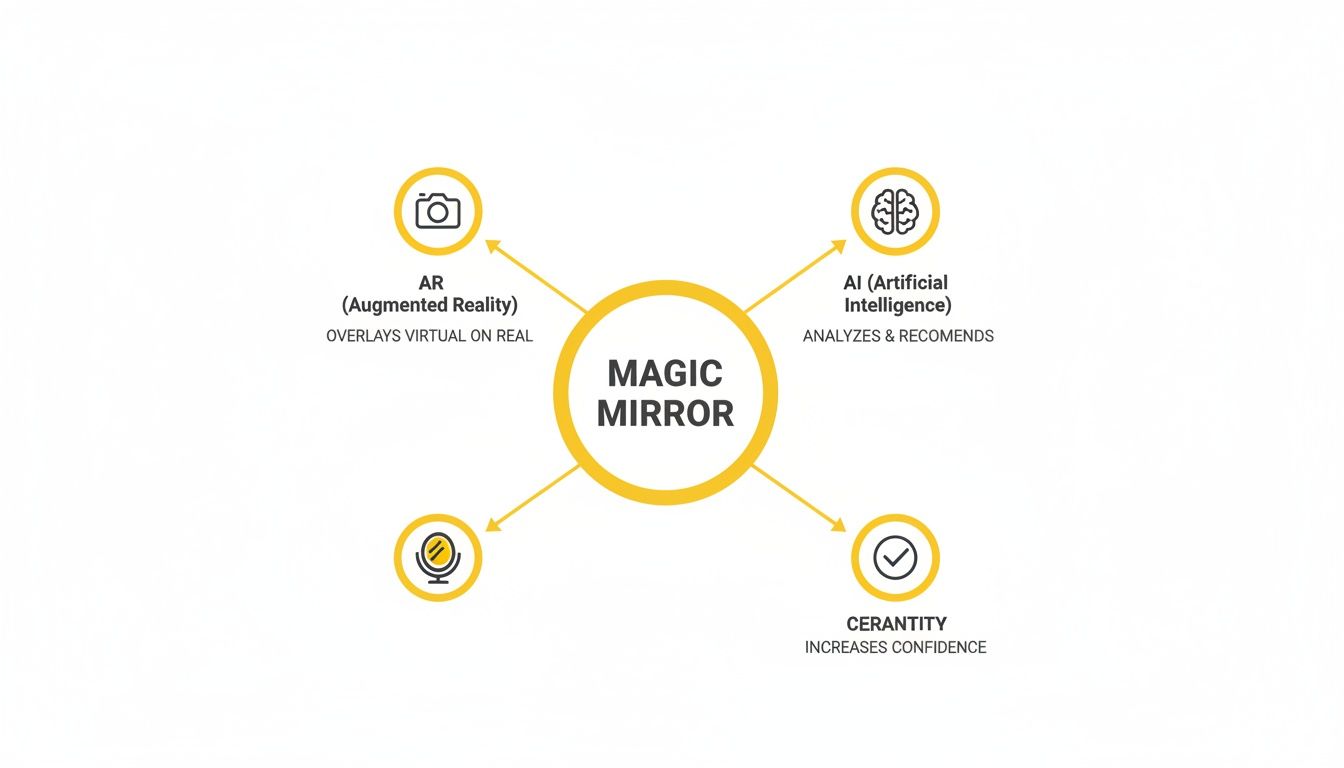
As you can see, the whole point is to build confidence. It lets users see products through an interactive lens, all powered by intelligent tech that understands space, shape, and appearance.
A Market That's Exploding
This isn't just a niche trend—it’s a massive shift in how people shop. The virtual try-on market is experiencing incredible growth, valued at an estimated USD 15.18 billion in 2025 and projected to soar to a staggering USD 48.10 billion by 2030.
This boom is fueled by the unstoppable rise of e-commerce and a new generation of shoppers who don't just want, but expect, interactive and personalized online experiences. North America might be leading the charge for now, but the Asia Pacific region is hot on its heels with a growth rate over 28%. It’s clear that VTO is quickly becoming table stakes for online retail.
The Business Case for Virtual Try On
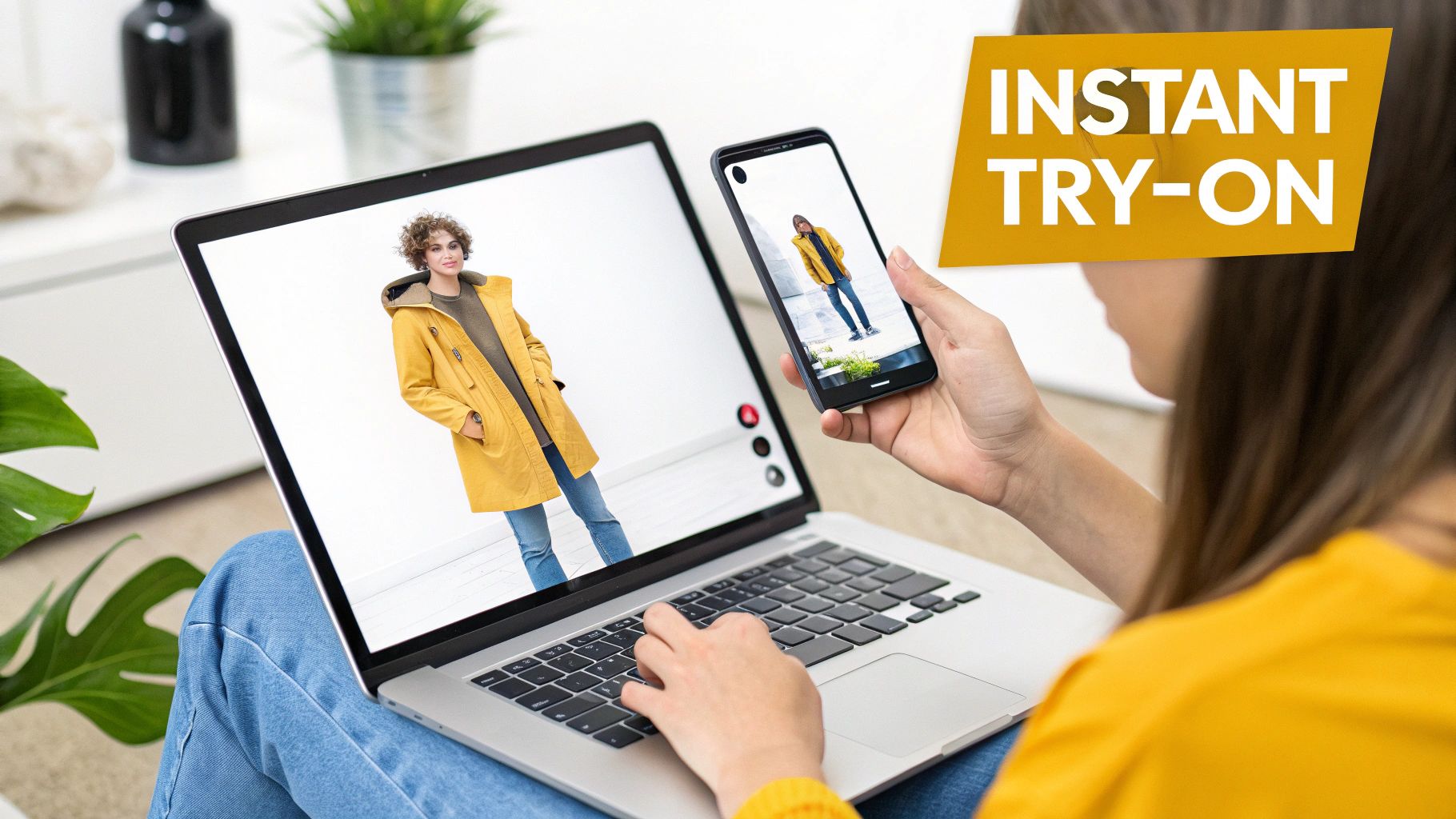
Beyond the cool factor, the real story behind virtual try-on (VTO) is how it directly fattens an ecommerce brand's bottom line. This isn't just about adding a neat feature to your website; it's a strategic move that tackles some of the toughest challenges in online retail, from shaky customer confidence to operational headaches.
For merchants, VTO is the tool that transforms a passive browser into a decisive buyer.
It works by addressing the single biggest question in online shopping: "How will this actually look on me?" When customers can see a realistic preview, that hesitation just melts away, clearing the path from "add to cart" to "complete purchase." Let’s break down exactly what that means for your business.
Slashing Costly Return Rates
Let's be honest, product returns are a nightmare. They aren’t just a logistical pain; they actively eat away at your profit margins through shipping fees, restocking labor, and often, inventory you can no longer sell. For clothing, the top reason for returns is almost always a bad fit or a disconnect between what a customer imagined and what arrived in the box.
Virtual try-on steps right into this gap.
By giving shoppers a solid preview of how a garment will drape and fit their body, you help them make a smarter choice from the get-go. Aligning their expectations with reality is the surest way to cut down on those "it just didn't look right" returns.
The numbers back this up. North America currently holds over 38.2% of the global virtual try-on market, a slice worth about USD 4.17 billion in 2024. Why? Because major retailers here jumped on the trend early and saw how it put a dent in returns, especially in apparel where a staggering 25-35% of online orders are typically sent back.
Lifting Conversion Rates and Boosting Sales
A confident shopper is a paying customer. It’s that simple. By getting rid of the doubt that plagues the online shopping experience, virtual try-on gives people the nudge they need to actually click "buy." This boost in confidence is arguably the most powerful benefit of the technology.
When a customer goes from asking, "Will this look good on me?" to thinking, "Wow, this looks great on me," the sale is already made. Virtual try-on is what powers that critical mental shift.
This confidence creates a ripple effect across your key metrics:
- Higher Conversion Rates: People who use a VTO feature are far more likely to follow through with a purchase than those who don't.
- Increased Average Order Value (AOV): Once a customer confirms an item looks great, they feel more adventurous. That confidence often leads them to add complementary items to their cart.
- Reduced Cart Abandonment: VTO provides that final bit of visual proof that can overcome last-minute jitters, a primary culprit behind abandoned carts.
Democratizing High-Quality Product Visuals
Not long ago, getting professional on-model photos was a luxury only big-budget brands could afford. The whole process—hiring models, photographers, stylists, and renting studio space—was a huge barrier for independent creators and most Shopify merchants.
Thankfully, modern virtual try on technology has completely flipped the script.
AI-powered platforms now let any brand, regardless of size, create gorgeous, on-model images from a single, simple product photo. You no longer need to coordinate a massive, expensive photoshoot just to show your designs on a diverse range of people.
This is a game-changer. For a closer look at how it works, our guide on using an AI product photo generator breaks it all down. This new approach doesn't just save a ton of time and money; it levels the playing field, allowing smaller businesses to compete with industry giants on pure visual appeal.
How to Implement Virtual Try On in Your Store
Bringing virtual try-on to your online store probably sounds like a massive technical project. You might be picturing expensive 3D modeling and a team of developers on standby. The good news is, modern AI platforms have changed the game completely, making it surprisingly straightforward to get started.
You can turn your product pages into interactive fitting rooms with just a few key steps. The real shift isn't technical; it's about thinking of virtual try-on as a core part of how you present your products, not just a flashy add-on. The goal is to build a seamless bridge between what you're selling and your customer's imagination.
Choosing Your Virtual Try On Partner
First things first: you need to select the right technology provider. This is the most important decision you'll make. You need a partner that fits your goals, budget, and how much technical heavy lifting you're willing (or able) to do.
For most e-commerce brands, especially those running on a platform like Shopify, the best bet is a solution that values simplicity and speed.
Look for partners that use an image-based AI approach. This is what makes modern virtual try-on so accessible. It completely removes the biggest historical roadblock: the need for complicated 3D scans. With a tool like PhotoMaxi, you can generate a stunningly realistic try-on experience using just a single, flat-lay product photo.
When you're vetting potential partners, keep these questions in mind:
- Easy Integration: How well does it play with your e-commerce platform? Look for a dedicated Shopify app or a simple, no-fuss integration process.
- Asset Requirements: Does it demand complex 3D models, or can it work its magic with the 2D product photos you already have?
- Visual Quality: Do the final images look believable and match your brand's aesthetic? The output needs to build trust, not make customers second-guess things.
- Scalability: Can the tool keep up as your business grows? It needs to handle a large product catalog and spikes in website traffic without breaking a sweat.
Preparing Your Product Assets for AI
Once you've picked your partner, it's time to get your product images ready. The best part about today's virtual try on technology is that you likely don't need a massive overhaul of your photography setup. In fact, clean and simple product shots are often the perfect ingredient.
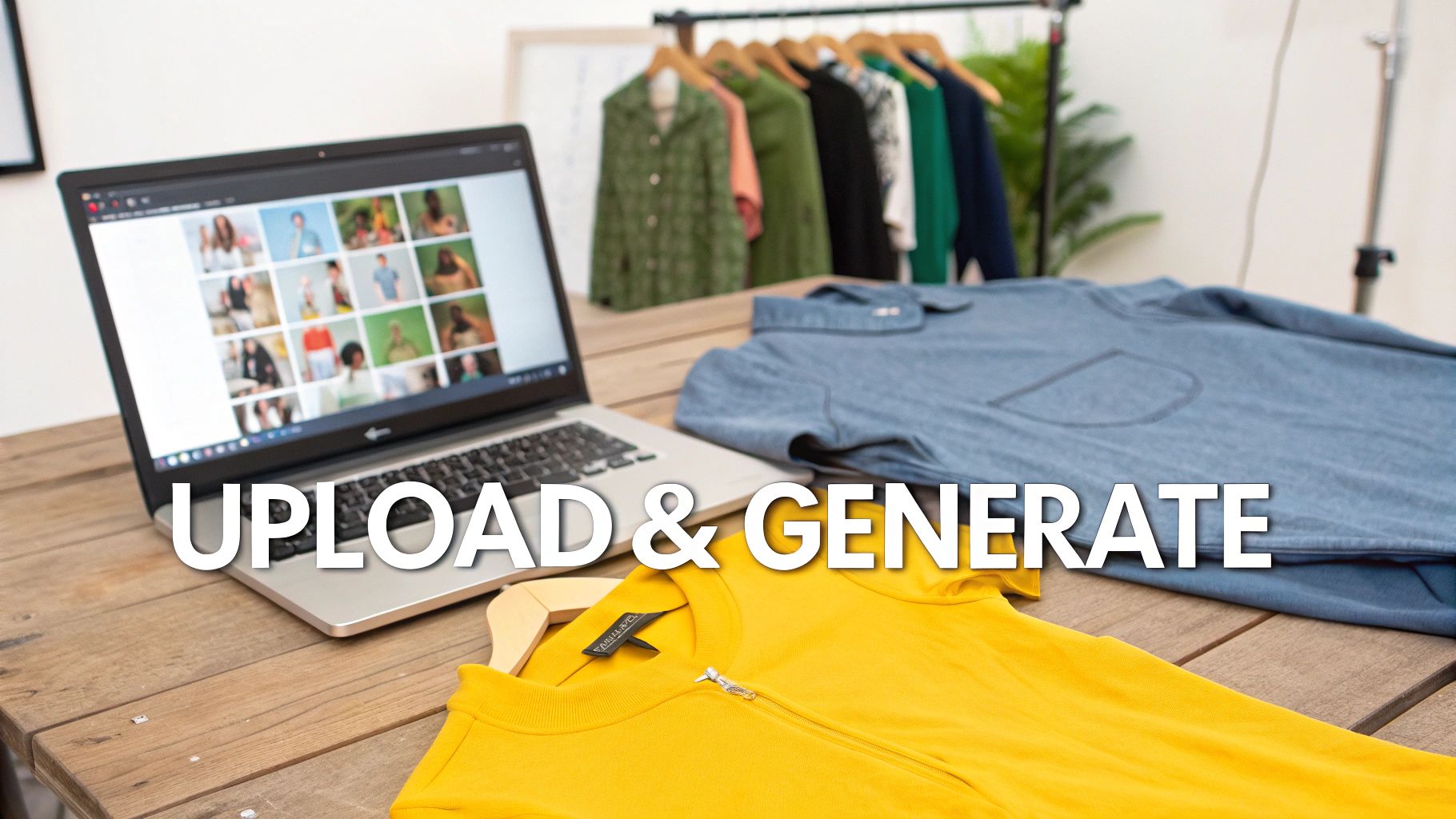
All the AI really needs is a high-quality, well-lit photo of your product against a neutral background. That single image becomes the raw material for creating countless on-model variations. Think of it like handing a lump of clay to a master sculptor. If you want to dive deeper into the process, you can learn more about how to create AI models from your own images.
This Shopify storefront is a great example of a clean product page that's ready for a virtual try-on feature.
A well-organized layout like this one makes it easy to add a "Try It On" button right next to "Add to Cart," making it a natural part of the customer's journey.
The Shopify Integration Workflow
For the millions of merchants on Shopify, adding virtual try-on is easier than ever. Most leading AI platforms now offer direct apps that plug right into your store, handling almost all the technical details for you. The whole process is designed for business owners, not developers.
To help you get started, here's a simple checklist that breaks down the steps for preparing and launching a virtual try-on feature on your Shopify store.
Virtual Try On Implementation Checklist for Shopify
| Step | Action Item | Key Consideration |
|---|---|---|
| 1. Partner Selection | Choose a VTO app from the Shopify App Store. | Look for strong reviews, clear pricing, and image-based AI capabilities. |
| 2. App Installation | Install the chosen app and grant permissions. | Ensure it integrates smoothly without conflicting with your theme or other apps. |
| 3. Asset Preparation | Gather high-quality, flat-lay product photos. | Clean, neutral backgrounds work best. Consistency is key across your catalog. |
| 4. Product Syncing | Allow the app to sync with your product catalog. | Verify that all relevant products, variants, and images are pulled in correctly. |
| 5. AI Model Generation | Use the app's dashboard to generate on-model images. | Experiment with different models and poses to find what resonates with your audience. |
| 6. Quality Control | Review the generated try-on images. | Check for realism, accurate product representation, and brand alignment. |
| 7. Page Integration | Publish the VTO feature to your live product pages. | Place the "Try It On" button in an intuitive, high-visibility location. |
| 8. Performance Test | Test the user experience on desktop and mobile. | Ensure it's fast, easy to use, and doesn't slow down your page load speed. |
| 9. Launch & Monitor | Announce the new feature and track key metrics. | Watch your conversion rates, return rates, and customer engagement. |
Following these steps methodically will ensure a smooth rollout and help you get the most out of your investment from day one.
The entire process transforms a static product grid into a dynamic, personalized showroom. What once took weeks of coordinating a photoshoot can now be done in a few hours, right from your Shopify dashboard.
This streamlined workflow puts powerful visualization tools directly into your hands. It makes a high-end e-commerce experience accessible to any brand, regardless of size. By following this clear path, you can successfully roll out virtual try-on and start seeing the rewards: higher conversions, fewer returns, and much happier, more confident customers.
Creating a Realistic and Trustworthy User Experience
A virtual try-on is only as good as the trust it inspires. If the experience feels clunky, slow, or obviously fake, it can actually do more harm than good, chipping away at the very confidence you’re trying to build. The real difference between a fleeting novelty and a powerful sales tool comes down to two things: realism and usability.
When a customer uses a virtual try on technology, they’re doing a quick mental check. Does this look believable? Does it really show what the product looks like? Getting a "yes" to these questions is the only way to turn a curious browser into a confident buyer.
The Pillars of a Believable Experience
To build that crucial trust, the user experience has to feel effortless and the visuals must be convincing. A grainy, distorted, or poorly rendered try-on immediately signals low quality, which reflects poorly on both the product and your brand.
Several core elements need to come together to create this sense of authenticity:
- High-Fidelity Visuals: The images or AR overlays have to be sharp, clear, and photorealistic. There can’t be any weird pixelation or digital artifacts that break the illusion.
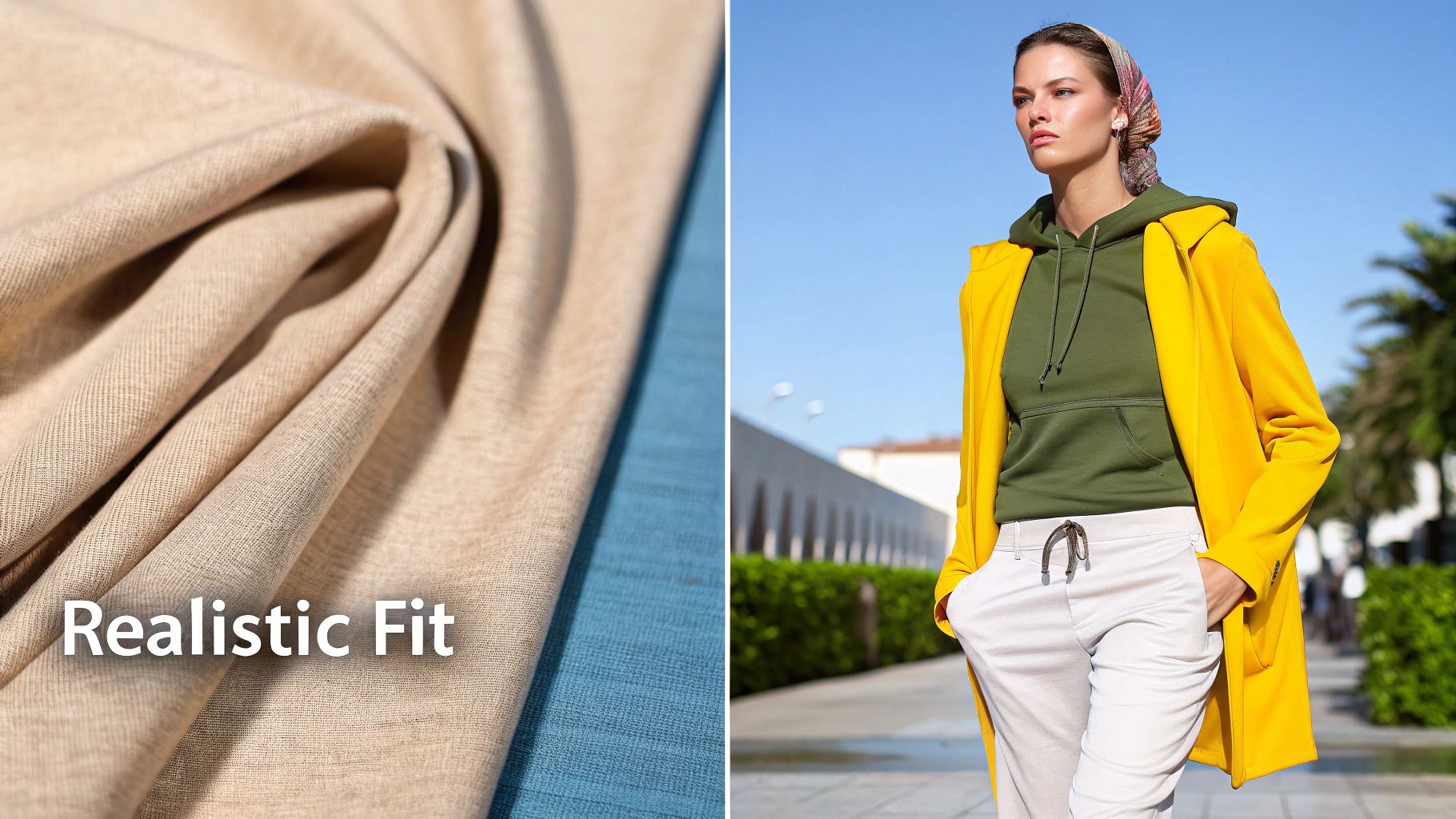
- Realistic Fabric Textures and Draping: The AI needs to understand how different materials behave in the real world. Silk should drape softly, denim should look structured, and knitwear needs to show its weight and texture. These are the details that make a virtual garment look like actual clothing.
- Accurate Sizing Representation: The tool has to show how a garment actually fits. It shouldn't just stretch the product unnaturally over a body; it should show how it would genuinely conform to different shapes and sizes.
A polished, seamless VTO is one of the most powerful trust signals you can add to your online store. It communicates quality, attention to detail, and a genuine commitment to helping the customer make the right choice.
This level of detail is what separates a gimmick from a genuinely helpful tool. It’s what assures the shopper that what they see on the screen is a faithful preview of what will arrive at their door.
Maintaining Brand Cohesion with AI
One of the biggest headaches with traditional on-model photography is consistency. Different photoshoots with various models, lighting, and locations often create a disjointed look across product pages. This subtle inconsistency can undermine a brand’s carefully crafted aesthetic.
Modern AI-driven virtual try on technology tackles this problem head-on. By using a consistent set of AI-generated models and pre-defined brand styles, you can guarantee every single product is showcased with the same high-quality, cohesive look. This makes for a much more professional and trustworthy shopping environment.
Optimizing the User Journey
Beyond the visuals, the experience itself must be intuitive and fast. A frustrating user interface will cause people to give up, no matter how realistic the final image is.
Think about these UX fundamentals:
- Fast Load Times: Customers expect instant results. The try-on experience should pop up in a few seconds, tops. Nobody wants to wait.
- Intuitive Controls: The "Try It On" button needs to be obvious, and the steps for uploading a photo or picking a model must be dead simple and clearly explained.
- Mobile-First Design: Let's face it, most online shopping happens on a phone. The entire virtual try-on flow has to work flawlessly on smaller screens and with touch controls.
At the end of the day, a trustworthy user experience is frictionless. It should feel like a natural, helpful part of shopping—not a technical hurdle to overcome. By focusing on both visual realism and seamless usability, brands can turn virtual try-on into an engine for building customer confidence and driving sales.
How to Measure Your Virtual Try-On Success
Rolling out virtual try-on technology feels like a huge accomplishment, but the real win is proving it actually works. To move past a "gut feeling" and build a solid business case, you need to connect the feature directly to your bottom line with hard data.
Think of it this way: you’ve hired VTO as a new team member to drive sales and make customers happier. Now it’s time for its performance review. This means digging deeper than surface-level stats and zeroing in on the Key Performance Indicators (KPIs) that show a tangible return on your investment.
Core Financial Metrics to Track
The numbers that really matter are the ones that directly impact your revenue and profit margins. These are the metrics that get the attention of your leadership team because they tell a clear story: is your VTO a neat gimmick or a genuine sales powerhouse?
Focus your energy on these three critical areas:
- Conversion Rate Uplift: This is the ultimate litmus test. The cleanest way to measure it is with an A/B test—show one group of visitors the product page with VTO and another group the page without it. A clear lift in conversions from the VTO group is the kind of undeniable proof you're looking for.
- Return Rate Reduction: Returns are a massive, silent killer of profit. Start by tracking your return rate for a solid period before VTO, then compare it to the period after you launched it. A noticeable drop is a huge victory. It means customers are making smarter, more confident choices.
- Average Order Value (AOV) Increase: When a shopper feels confident about how one item will look, they're often more open to adding another to their cart. Keep an eye on your AOV. Do shoppers who use the try-on feature spend more per transaction than those who don't?
Proving ROI isn't about guesswork; it's about connecting the dots between customer interaction and financial outcomes. A successful VTO strategy will show clear improvements in how customers shop and how much they spend.
This data-backed approach shifts your virtual try-on technology from a speculative expense to a proven asset.
Measuring Customer Engagement
While the financial KPIs tell you the "what," you also need to understand the "how" and "why." How are customers actually using the tool? Engagement metrics give you a window into the user experience and pinpoint where you can make improvements.
Start by tracking these key data points:
- Interaction Rate: On a product page with VTO, what percentage of visitors actually click the "Try It On" button? A high interaction rate means the feature is easy to find and compelling enough to use.
- Dwell Time: How much longer are people sticking around on product pages that have a VTO option? More time on page is almost always a sign of higher purchase intent.
- Sharing and Saving: Are users saving their try-on photos or sharing them on social media? This is a fantastic sign that they’re not just browsing—they're highly engaged and see real value in the experience.
These insights help you fine-tune the customer journey and squeeze every bit of value out of the tool. And the financial results are hard to ignore. We've seen immersive AR experiences boost average order values by up to 20%. This tech is completely changing the game in apparel, where it helps tackle the staggering 30%+ return rates that cost the industry billions.
You can learn more about the economic impact of virtual fitting rooms from industry reports. By tracking both the money and the engagement, you get a complete, 360-degree view of your VTO's success.
The Future of Shopping Is Virtual
We're really just scratching the surface of what virtual try-on technology can do. The AR filters and AI-generated model photos we see today are just the beginning—think of them as the foundational layer for a future where the lines between physical and digital shopping completely disappear.
What's coming next will feel less like a tool and more like magic. The next wave of VTO is about creating experiences that aren't just convenient but deeply immersive, moving seamlessly between the real world and virtual spaces. This isn't some far-off sci-fi concept; it's the direction virtual commerce is heading right now.
The Rise of Hyper-Personalization
The next big leap is AI that doesn't just show you a product, but acts as your personal stylist. Imagine an AI that learns from every single item you virtually try on. It will pick up on your go-to colors, the fits you feel best in, and the styles you keep coming back to.
Before you know it, this digital stylist will be curating collections just for you, offering suggestions that feel less like an algorithm and more like advice from a trusted friend. This shifts VTO from a simple visualization tool into a proactive, personal shopping guide, turning product discovery into a genuine conversation.
Blurring the Lines Between Worlds
As VTO starts to connect with other digital frontiers like the metaverse, the very idea of owning a product will change. Soon, you won’t just try on a jacket for yourself; you’ll try it on your digital avatar at the same time. Brands will start selling a physical item bundled with its "digital twin" for you to use in your favorite online worlds.
This opens up brand new ways for businesses to make money and connect with customers. We're also seeing the early stages of other sensory experiences taking shape:
- Hyper-Realistic 3D Showrooms: Imagine walking through a brand's entire collection in a stunningly rendered virtual store, all from the comfort of your couch.
- Haptic Feedback: In the near future, your devices could let you feel the texture of fabric through your screen—the smoothness of silk or the ruggedness of denim.
The end game is a shopping experience where you can't tell the difference between digital and physical. You won't just see a product; you'll feel it, sense it, and truly experience it before you ever hit "buy."
This connected future ensures that as our lives move more online, our shopping habits will naturally follow. The tools that once felt like science fiction are quickly becoming the essential building blocks for this new age of commerce, making these incredible experiences available to every brand, not just the tech giants.
Your Virtual Try-On Questions, Answered
If you're thinking about bringing virtual try-on to your brand, you probably have a few questions. That's a good thing. Getting your head around the costs, technical requirements, and what it can really do is the first step. Let's clear up the most common questions we hear from merchants just like you.
How Much Does It Cost to Implement Virtual Try-On?
The price tag for virtual try-on can swing wildly, and it really depends on the path you take. Building a custom Augmented Reality (AR) solution from the ground up? That’s a serious investment, often reserved for enterprise-level brands with dedicated development teams.
But that’s the old way of thinking. Today, AI platforms that create try-on images from your existing 2D photos have completely changed the game. Many now offer straightforward subscription plans that are well within reach for small businesses and Shopify merchants. Often, these tools are bundled with other helpful content features, so you get a lot more bang for your buck.
Do I Need 3D Models of My Products?
This used to be the biggest roadblock for most brands, but the answer now is a resounding no. For a long time, the only way to do virtual try-on was with complex, expensive 3D models. The time and cost involved kept this tech out of reach for almost everyone.
That barrier is gone. Modern AI systems can take a single, flat photo of your product and generate incredibly realistic on-model imagery. This leap forward means you can get a virtual try-on experience up and running fast, without needing a technical artist or a massive budget.
The move from mandatory 3D models to simple 2D image processing is what finally made virtual try-on accessible to everyone. It puts powerful visualization tools into the hands of any creator or shop owner.
How Accurate Is Virtual Try-On for Sizing?
This is a great question, and it's where we see a lot of innovation happening. Sizing accuracy really depends on the type of technology you're using.
Live AR try-ons, which use your phone's camera, are fantastic for giving you a general idea of how something will look on your frame or in your space. Think of it as a digital mirror.
AI image generation, on the other hand, is all about nailing the style. It’s designed to show you how the fabric drapes, how the color looks against a certain skin tone, and whether the overall aesthetic fits your vibe. It tackles the "I'm not sure if this is my style" problem head-on. Now, many of these systems are starting to integrate sizing data to provide smarter recommendations, closing the gap between style and fit.
Can VTO Be Used for Products Besides Clothing?
Absolutely! Apparel is just the beginning. The tech is incredibly flexible and works wonders for any product where seeing it in context helps a customer make a decision.
Some of the most popular uses we see are for:
- Cosmetics: Letting shoppers swipe through lipstick shades or test eyeshadow palettes.
- Eyewear: Seeing exactly how different frames will look on your face.
- Accessories: Visualizing how a watch sits on your wrist or how a necklace will hang.
- Home Goods: Using AR to place a virtual sofa in your living room to see if it fits the space and matches your decor.
Basically, if your customers need to visualize it to believe it, VTO can help.
Ready to stop guessing and start showing? With PhotoMaxi, you can create realistic virtual try-on experiences from a single product photo, boosting sales and slashing returns. Get started with your AI photographer today at photomaxi.com.
Ready to Create Amazing AI Photos?
Join thousands of creators using PhotoMaxi to generate stunning AI-powered images and videos.
Get Started Free