
Unlocking Creativity with AI Content Creation Tools
At its heart, an AI content creation tool is a piece of software that uses artificial intelligence to generate brand-new content. We’re talking about everything from text and images to video and audio. These tools learn from massive datasets to produce original work based on your specific instructions, essentially acting as a creative partner to help you make more content, faster.
What Exactly Are AI Content Creation Tools?
It’s helpful to think of these tools not as lines of code, but as a team of specialized creative assistants on standby. They're ready to write, design, or even compose whenever you need them. The magic behind them lies in sophisticated algorithms trained on an incredible amount of existing content—think countless articles, books, photographs, and films.
A good analogy is a student who has spent their entire life reading every book in a giant library. They haven't memorized each page, but they've absorbed the patterns of language, the structures of a good story, and the principles of visual design. When you ask them to write an essay on a new topic, they can draw on that vast knowledge to create something completely original. AI tools work much the same way, using their training to generate fresh content based on the instructions, or prompts, you provide.
The Problem They Solve for Creators
The core issue these tools tackle is the never-ending demand for great content. For creators, marketers, and agencies, keeping up a steady flow of fresh material is a huge drain on time and resources. AI offers a way to radically boost efficiency and break through those creative bottlenecks. This isn't just a fleeting trend, either—it's a booming market.
The market for AI-powered content creation has grown incredibly fast, carving out a major space in the tech industry. It was valued at USD 2.15 billion in 2024 and is expected to rocket to USD 10.59 billion by 2033, growing at an impressive 19.4% annually. You can dig into more data on the AI content market's projected growth to see just how much it's reshaping creative workflows. This kind of growth points to a fundamental change in how we create.
The real power of AI content tools is their ability to do the heavy lifting. They can draft blog posts, mock up social media graphics, or generate professional product photos, which frees you up to focus on strategy, final edits, and the bigger creative vision.
Key Categories of AI Content Tools
These digital assistants come in several flavors, each built for a specific creative task. While new platforms pop up all the time, they generally fit into four main buckets:
- Text Generation: Tools that write anything from blog articles and ad copy to emails and video scripts.
- Image Generation: Platforms that produce visuals like illustrations, photorealistic images, and custom brand assets.
- Video Generation: These tools can create new video clips, edit existing footage, or produce animations from a simple prompt.
- Audio Generation: This category covers everything from AI-powered voiceovers and background music to custom sound effects.
Once you understand these basic functions, it becomes much easier to see how ai content creation tools can slot into just about any workflow to get better results in less time.
Exploring the Modern AI Creator's Toolkit
So you've wrapped your head around AI assistants. Now, let's open up the digital toolbox and see what’s inside. The world of AI content creation tools isn't a one-size-fits-all affair; it's a sprawling collection of specialized instruments built for just about every creative task you can imagine.
Think of it like a chef's kitchen. You wouldn't use a bread knife to peel a potato, right? The same logic applies here. Getting the best results from AI means picking the right tool for the job, whether you're outlining an article, mocking up a social media post, or piecing together a short film.
These tools have quickly moved from the fringes to the very center of modern workflows. In fact, the software segment of the AI content market already commands about 65% of the market share and is growing at an incredible pace. This trend, highlighted in a report on the expanding AI content software market from Roots Analysis, shows just how much we're leaning on these solutions to work smarter.
Text Generators for Articles and Copy
For most people, text generators are their first dip into the AI pool. These are the wordsmiths of the AI world, capable of churning out everything from in-depth blog posts and compelling ad copy to clever email subject lines and entire video scripts.
It all starts with a simple prompt. You tell the AI what you need, and it generates human-like text to match your instructions. For instance, a marketer could ask for "five taglines for a new vegan protein bar that sound energetic and inspiring," and get a list of solid options in seconds. This completely changes the game for brainstorming and getting that first draft down.
Image Creators for Stunning Visuals
Next up are the visual artists in the toolkit: image generators. These AI platforms are brilliant at turning simple text descriptions into one-of-a-kind, high-quality images. They can act as your personal digital artist, photographer, or graphic designer, ready to create photorealistic product shots or whimsical fantasy art on command.
Let's say you need a very specific image for your blog, like "a golden retriever wearing sunglasses and sitting on a surfboard." Instead of endlessly scrolling through stock photo sites, an AI image creator can whip up that exact scene for you. For brands, this means creating perfectly on-brand visuals without the cost and hassle of a photoshoot. To see what's out there, you can explore our guide on the best AI tools for content creation.
The real magic of AI image creation isn't just about saving time. It's about being able to bring a precise creative vision to life instantly. This gives creators a level of visual control that used to require a serious budget.
Video and Audio Synthesis Tools
The toolkit doesn't stop at static content. It also covers the dynamic worlds of motion and sound. Video synthesis tools can create short clips from text, produce slick animations, or even help edit your existing footage. An influencer, for example, could type out a few scene descriptions and have an engaging animated explainer ready for TikTok in minutes.
On the audio front, these tools can handle voiceovers, custom background music, and sound effects. Need a calm, professional narrator for a product demo? AI can generate it in the time it takes to make a coffee, saving you the expense of hiring a voice actor.
AI Content Tool Categories and Their Best Uses
With so many options, how do you pick the right tool? It all comes down to what you're trying to accomplish. To help you navigate the landscape, we've broken down the main categories of AI tools and what they're best used for.
| Tool Category | Primary Function | Ideal For | Example Use-Case |
|---|---|---|---|
| Text Generation | Writes original copy and articles based on prompts | Bloggers, Marketers, SEO Specialists | Drafting an SEO-optimized article about sustainable travel |
| Image Creation | Produces unique visuals from text descriptions | Social Media Managers, Designers, Brands | Generating custom lifestyle images for an Instagram campaign |
| Video Synthesis | Creates or edits video clips and animations | YouTubers, Advertisers, Educators | Making a short animated promo video for a new mobile app |
| Audio Generation | Produces voiceovers, music, and sound effects | Podcasters, Filmmakers, Marketers | Creating a royalty-free background music track for a video ad |
By understanding these distinct categories, you can start building an AI creator's toolkit that truly works for you. The key is to select the specific instruments that will enhance your unique creative process and help you bring your ideas to life faster and more effectively than ever before.
How Real Businesses Are Using AI Content Tools
Theory is great, but seeing AI content creation tools in the wild is when it all clicks. Let's move past the abstract and look at how these tools solve real problems for real people. We'll walk through four different scenarios, each showing how a specific challenge gets a smart, AI-powered solution.
These aren't just hypotheticals. They show how professionals—from solo creators to bustling agencies—are using AI to get over hurdles, save a ton of money, and frankly, just do better work. It’s all about turning a creative roadblock into a smooth, fast-moving workflow.
The Social Media Influencer Beating Burnout
First up is Alex, a travel influencer with a great community. The problem? Alex's audience expects new content every single day, but it’s physically impossible to be shooting in a new country every 24 hours. The pressure was immense, leading to serious creative burnout and a dip in quality.
Alex found a solution in an AI visual platform. After training an AI model on a handful of their best photos, they could suddenly generate an endless stream of new, on-brand images. One minute Alex is in their home office; the next, their AI-generated self is posing in front of the Eiffel Tower or exploring the streets of Tokyo.
This completely solved the consistency issue. Alex now uses PhotoMaxi to create entire batches of assets for Instagram and TikTok, keeping the feed fresh and engaging. With the AI handling the heavy lifting of visual production, Alex has more time to actually engage with the community and plan the next real adventure.
The Shopify Store Owner Who Needs Endless Product Shots
Next, let's look at Maria. She runs a fantastic Shopify store selling handmade jewelry, but her biggest bottleneck was product photography. Every new collection meant a huge investment of time and money for photoshoots—hiring models, stylists, and photographers. It was slowing down her ability to launch new pieces.
Maria needed a way to get professional, studio-quality photos without the traditional overhead. She started using an AI tool that could take one clean photo of her jewelry and place it on countless AI-generated models or in different lifestyle settings.
With a tool like PhotoMaxi, Maria can now generate hundreds of product shots for a new earring design in minutes. She can see it on different models, against various backgrounds, and in multiple lighting styles to find what converts best—all from a single product photo. This has cut her visual asset creation time by over 90%.
Not only does this save her thousands of dollars with every launch, but it also gives her the agility to test new visuals on the fly and respond to what her customers love. For anyone in ecommerce, this is a total game-changer.
The Marketing Agency Under Constant Pressure to Deliver
Now, picture a busy marketing agency juggling a dozen clients. Every client has its own brand guidelines and a bottomless appetite for new ad creatives, blog visuals, and social media posts. The agency's design team was swamped, spending most of its day on repetitive, small-scale tasks instead of big-picture creative thinking.
The agency decided to build a suite of AI content creation tools right into its workflow. (For a closer look at how agencies are doing this, our guide on AI tools for marketing teams has more great examples.) They started using text generators for first drafts of ad copy and AI image platforms to brainstorm a wide range of visual concepts for client approval.
This shift was massive. They could now produce campaign assets at a scale they'd only dreamed of. For a single campaign, they could generate 50 different ad variations in the time it used to take them to produce just five. This led to smarter A/B testing, better-performing ads, and much happier clients, all while freeing up their designers to focus on high-impact brand strategy.
The Independent Filmmaker on a Shoestring Budget
Finally, meet Ben, an indie filmmaker with a passion project and a very tight budget. He needed to create concept art, storyboards, and even some simple visual effects, but he couldn't afford to hire a team of artists.
Ben started exploring AI tools built for visual and video creation. He used an AI image generator to create incredibly detailed concept art, which helped him secure funding by giving investors a crystal-clear vision of his film's look and feel. He even used an image-to-video feature to turn his static storyboards into simple animated sequences, helping him nail the film's pacing.
For Ben, AI wasn't a replacement for creativity; it was a partner. It leveled the playing field, giving him access to production tools that were once only available to massive studios. It allowed him to bring his vision to life without making compromises because of his budget.
How to Choose the Right AI Tool for Your Goals
With a flood of AI content creation tools hitting the market, picking the right one can feel like trying to find a specific needle in a rapidly growing haystack. Every platform promises amazing results, but the real question is, which one actually solves your problem? The secret is to tune out the marketing noise and focus on what you’re truly trying to accomplish.
Instead of getting lost in endless feature lists, start by asking a simple question: What is my primary objective? Are you trying to pump out content faster to hit deadlines? Are you aiming for a level of quality you couldn't reach before? Or is this all about cutting production costs? Your answer instantly cuts the field in half.
A tool built for speed might prioritize quick generations over granular control, making it perfect for drafting dozens of social media captions. On the other hand, a tool focused on quality will offer more knobs and dials but demand more of your time—ideal for creating that one perfect hero image for a major campaign.
Define Your Balance of Control and Simplicity
Every AI tool lives somewhere on a spectrum between dead-simple and deeply complex. Some are designed for total beginners, offering a clean interface where you can get impressive results with minimal effort. These are fantastic for individuals or teams who need to move fast and not get bogged down in technical weeds.
Others are built for professionals, providing a massive suite of controls that let you meticulously shape every aspect of the final product. This level of precision is non-negotiable when you have a very specific creative vision. Figuring out where you sit on this spectrum is a critical step to avoid choosing a tool that leaves you feeling either boxed in or completely overwhelmed.
The flowchart below can help you map your business challenge to the right kind of AI solution.
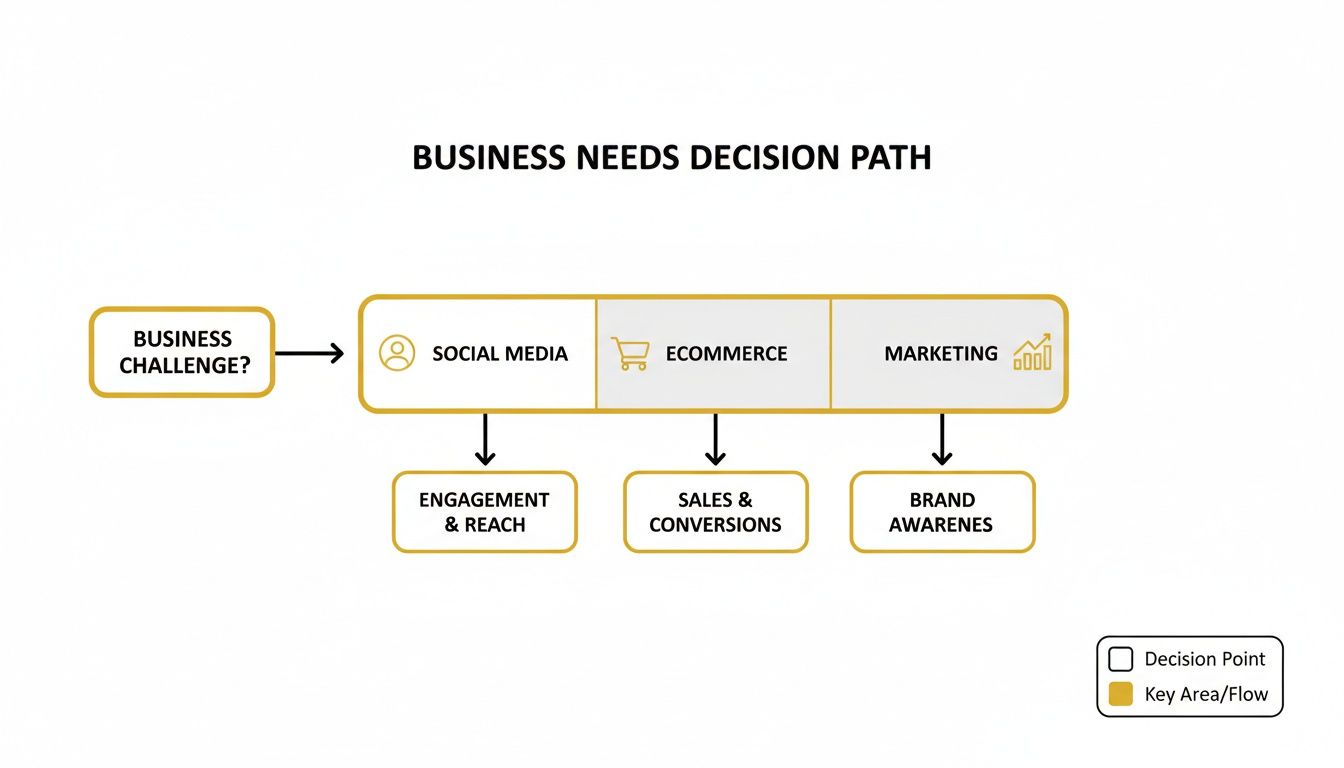
This visual guide shows how different business needs—from driving social media engagement to boosting e-commerce sales—point toward different types of AI tools to get the job done right.
Focus on Non-Negotiable Features
For any serious creator or business, some features aren't just "nice-to-haves"—they're absolute deal-breakers. When it comes to visual content, two of the most critical are character consistency and likeness fidelity.
Let’s be honest: many generic AI image generators just can't create the same face or character across multiple images. You end up with a cast of strangers, which makes your brand look disjointed and unprofessional. This is a complete non-starter for building a brand identity, telling a coherent story, or even just maintaining a consistent Instagram feed.
When you're testing out a tool, ask yourself: Can this platform reliably show my character in different poses, outfits, and scenes? If the answer is no, it’s not a commercially viable tool for most visual projects.
This is precisely where a specialized tool like PhotoMaxi shines. The entire platform was engineered to solve this very problem, ensuring your AI-generated models have a consistent and dependable look every single time. That kind of reliability is crucial, whether you’re creating an entire marketing campaign or just starting to explore AI for video creation.
Understand the Pricing and Usage Rights
Finally, don't forget to look at the fine print. Dig into the pricing models and—just as important—the commercial usage rights. AI tools typically run on a subscription or a credit-based system. Think about your expected output to figure out which model makes the most financial sense for you.
Here’s a quick checklist to guide your final decision:
- Primary Goal: Is it speed, quality, or saving money?
- User Experience: Do you need a simple one-click solution or advanced creative controls?
- Consistency: Can the tool maintain a character's likeness across dozens of images?
- Commercial Rights: Does your plan give you a clear license to use the content for your business?
- Workflow Integration: Does it play nice with the other software you already use, like Shopify or WordPress?
By walking through these questions, you can cut through the clutter and confidently pick an AI content creation tool that not only meets your creative standards but also aligns perfectly with your business goals.
Navigating the Common Challenges of AI Content
While AI content creation tools have incredible potential, it’s important to go in with your eyes open. These aren't flawless magic wands; they're powerful instruments that still need a skilled hand to produce professional results. Simply hitting "generate" without understanding the common pitfalls can lead to strange, unprofessional content that actually hurts your brand.
Think of an AI model as an incredibly knowledgeable and creative partner who, despite all their talent, has never actually lived in the real world. It can generate a beautiful image or write a compelling paragraph because it's a master of patterns, but it doesn't truly understand context, physics, or facts. That gap is where most of the weirdness begins.
The good news? These issues aren’t deal-breakers. Once you know what to look for, you can easily navigate them with the right strategies and, in some cases, the right specialized tools.
Tackling Text and Image Imperfections
In AI-generated text, the most infamous problem is the "hallucination." This is when a language model states something completely false with total confidence. It isn’t trying to lie—it’s just assembling words that are statistically likely to follow one another, even if the resulting "fact" is pure fiction. That's why you always have to fact-check any claims or data it produces.
The visual side of AI has its own well-known quirks. We've all seen the classic AI oddities: the portrait of a person with six fingers, a coffee cup melting into the table, or a sign with text that looks like a forgotten alien language. These mistakes happen because the AI is recreating visual patterns without a fundamental grasp of anatomy or how objects behave in the real world.
For creators and brands, these glitches are more than just a funny meme. They make your content look amateurish. An even bigger headache, especially for storytelling, is the lack of consistency. Most general-purpose image generators can't reliably recreate the same person or character in different scenes, which is a non-starter for building a brand identity or a narrative.
This is exactly where specialized AI content creation tools like PhotoMaxi step in. The platform was built from the ground up to solve the consistency problem, focusing on dependable face likeness to make sure your AI-generated people look like the same person in every single shot.
Mitigating Risks and Ensuring Professional Quality
Despite these challenges, marketers are jumping on board because the upside is just too good to ignore. A recent study found that 93% of marketers use AI to create content faster, and 83% say it frees them up for more important strategic work. You can dig into more stats about AI's impact on marketing efficiency from SEO.com. The takeaway is clear: the goal isn’t to find a perfect, hands-off tool, but to learn how to manage its imperfections.
Here are a few practical steps to keep your quality high:
- Keep a Human in the Loop: Never, ever publish raw AI output without a human review. Your expertise is the final, essential ingredient for editing, fact-checking, and adding the strategic nuance that AI misses.
- Pick the Right Tool for the Job: For something as critical as a character’s appearance, don't use a general-purpose tool. A specialized platform will always outperform a jack-of-all-trades.
- Master Your Prompts: The quality of your output is a direct reflection of your input. Learning to write clear, detailed, and specific prompts is the single best way to guide the AI toward the result you actually want.
- Don't Be Afraid of Post-Production: Treat AI-generated images like a first draft. A quick touch-up in a photo editor can easily fix the small visual flaws that might otherwise ruin a great image.
By understanding the limitations and building a workflow to address them, you can turn AI from a simple content generator into a truly reliable creative partner.
The Future Is a Human and AI Partnership
The whole conversation about AI content creation tools often gets stuck on a "human vs. machine" narrative. Honestly, that completely misses the point. The real story isn't about replacement; it’s about a powerful collaboration. Think of it as AI becoming your creative co-pilot, a tool that supercharges human ingenuity, not one that makes it obsolete.
The creators and brands who truly succeed will be the ones who figure out this partnership. It's like a master carpenter getting a set of unbelievable power tools. The tools don't have the vision, the taste, or the story to tell, but they can execute incredibly complex tasks with speed and precision. This lets the carpenter focus on pure artistry. That’s the new creative workflow.
Redefining the Creator’s Role
When you hand off the repetitive, soul-crushing parts of content production to an AI, you’re free to work on a completely different level. Instead of spending hours meticulously editing photos one by one or banging your head against the wall writing dozens of social media captions, you can pour that energy into what actually moves the needle.
This shift lets you focus on the good stuff:
- Big-Picture Strategy: Thinking about your brand's story and where you want to go long-term.
- Deep Storytelling: Creating messages that actually connect with people and make them feel something.
- Community Connection: Genuinely engaging with your audience and building real relationships.
When an AI like PhotoMaxi can take over generating endless visual variations for all your different platforms, your job title effectively changes from "production grunt" to "creative director." You're the one with the vision; the AI just handles the legwork, letting you scale your output without burning yourself out.
The goal isn't to automate creativity—it's to augment it. By letting AI handle the mechanical parts of making content, you free up your time and brainpower for the strategic and emotional work that only a human can do.
Your Invitation to Experiment
The absolute best way to wrap your head around this new reality is to just jump in and start playing around. Don’t look at these tools as just a shortcut to work faster. See them as a key that unlocks creative doors that used to be locked shut by budget, time, or technical skill gaps.
Just imagine it: generating an entire fantasy world for a video project or producing a professional-quality product photoshoot without ever leaving your living room. That's not science fiction; it's what's possible today. A great first step is to give a platform like PhotoMaxi a single image and just watch what happens. See how it can spin your one idea into a whole library of on-brand assets.
This isn't just a tech shift; it's a creative one. Embrace these tools, get a feel for what they do best, and discover how they can amplify your unique voice. The future of content creation belongs to those who learn to collaborate, turning AI from a simple tool into a true creative partner.
Common Questions About AI Content Tools
Diving into the world of AI content creation tools naturally brings up a few questions. When you start weaving these powerful platforms into your work, it’s smart to get clear on the legal, professional, and practical side of things. Let's tackle some of the most frequent questions we hear.
Is AI-Generated Content Okay to Use for My Business?
Yes, for the most part, it is. The key thing to remember is that your right to use the content is dictated by the terms of service of the specific AI tool you're using. Many platforms, especially their paid or commercial plans, will give you a license to use what you create for your business.
That's why it's absolutely essential to read the licensing agreement before you put any AI-generated asset into a commercial project. When it comes to visuals, a huge advantage of using tools that create completely synthetic models is that you sidestep the headache of model release forms and usage rights that come with traditional photoshoots. It just makes life simpler.
Are AI Content Tools Going to Replace Creative Professionals?
The general feeling across the creative industries is that these tools will enhance creative jobs, not eliminate them. Think of them as incredibly capable assistants that can take over repetitive tasks, brainstorm initial concepts, and churn out assets at a scale that was previously impossible.
This change allows human professionals—designers, writers, photographers, and marketers—to focus their energy on what they do best: high-level strategy, creative direction, and building client relationships. The professionals who thrive will be the ones who master using AI to get better results, faster. It's a partnership, not a hostile takeover.
AI handles the mechanical production, while the human creator provides the vision, taste, and strategic direction. This collaborative approach leads to a more efficient and creatively fulfilling process.
How Can I Make Sure My AI-Generated Images Look Consistent?
Getting a consistent look for a character or brand is a massive hurdle with most general-purpose AI image generators. The solution is to seek out specialized tools built from the ground up to solve this exact problem.
Platforms like PhotoMaxi are engineered to deliver that consistency. They let you train the AI on a specific face or character, ensuring that the same person appears perfectly across hundreds of different images, poses, and scenes. That kind of reliability is non-negotiable for building a recognizable brand, maintaining a cohesive social media feed, or producing a video where a character needs to be instantly recognizable from shot to shot.
Ready to generate stunning, on-brand visual content with perfect consistency? PhotoMaxi acts as your personal AI photographer, creating studio-quality images and videos from a single upload. Start creating for free today at PhotoMaxi.
Related Articles


Ready to Create Amazing AI Photos?
Join thousands of creators using PhotoMaxi to generate stunning AI-powered images and videos.
Get Started Free