
Ai tools for marketing teams that boost creativity and outcomes
Let’s be honest, AI tools aren't just a "nice-to-have" for marketing teams anymore. They've become a core part of the modern toolkit. Think of them as a powerful co-pilot, handling the tedious but necessary work so your team can focus on what really matters: strategy and creativity.
Why AI Is Your New Marketing Co-Pilot
Imagine your marketing team is flying a plane through a crowded, constantly changing sky. The mission? Reach your audience and deliver your message. For years, you’ve been at the controls manually, wrestling with campaign setups, pouring over data, and spending endless hours creating content. It's exhausting.
Now, you have a digital co-pilot. This isn't about handing over the controls and hoping for the best. It's about augmenting your own skills. This co-pilot can track thousands of data points at once, spot the most efficient routes, and run all the routine system checks. That frees you up to focus on the big picture—the flight plan. That's exactly how AI tools for marketing teams work. They aren't here to replace human ingenuity; they’re here to amplify it.
The Shift from Niche to Necessity
It wasn't that long ago that AI felt like an experiment for most marketing departments. Today, it’s practically standard issue. This shift isn’t just a feeling; the numbers back it up.
Between 2022 and 2025, spending on AI marketing tools went through the roof. What was once a speculative investment for a few has become a must-have budget item for almost everyone. Research from Digiday highlights this perfectly: back in 2022, only 44% of brand and agency pros said their companies were investing in AI. Fast forward to 2025, and that number is projected to hit 86%. That means nearly nine out of ten marketing teams now plan for AI in their budget.
AI’s real job is to take on the repetitive, data-heavy tasks that can be done at scale. This lets human marketers get back to what they do best: understanding people, telling great stories, and making sharp strategic calls.
Augmenting Human Strategy, Not Replacing It
The goal here is a smarter division of labor. AI lets your team offload the grunt work that causes burnout and creates bottlenecks, which in turn opens up more time for genuine innovation.
Here’s how that partnership looks on the ground:
- Creative Scalability: Instead of a designer spending a full week creating five ad variations, an AI tool can spin up hundreds in minutes. This lets the team jump straight to A/B testing and analyzing what actually works.
- Data-Driven Insights: An AI analytics platform can comb through millions of data points to flag an emerging trend, while your strategist uses that insight to make a smart pivot in the campaign.
- Workflow Automation: Mundane tasks like scheduling social media posts or creating simple video cuts get handed off to automation. If you want to see this in action, check out our guide on using AI for video creation.
Ultimately, this collaboration between people and technology builds a faster, more creative, and more effective marketing engine. At this point, it’s a practical necessity for staying in the game.
Decoding the 5 Types of AI Marketing Tools
Jumping into the world of AI marketing tools can feel a bit like trying to navigate a sprawling, chaotic city for the first time. Every vendor is shouting about their game-changing solution, and it’s easy to feel lost. But here's the secret: once you learn the layout of the city, you can move through it like a local.
The entire AI marketing landscape really boils down to five core pillars. Each one is designed to solve a specific, nagging problem that every marketing team faces.
Think of these pillars less as separate tools and more like specialized experts on your team. You have the creative genius, the data scientist, the customer whisperer, and the hyper-efficient project manager. They all have different jobs, but they work together to build a marketing machine that's smarter, faster, and more effective. Understanding these categories is the first step to figuring out where you need help the most.
As the diagram below shows, AI isn't just one thing. It's a co-pilot that sits at the center of your operations, connecting the dots between data, creativity, and execution.
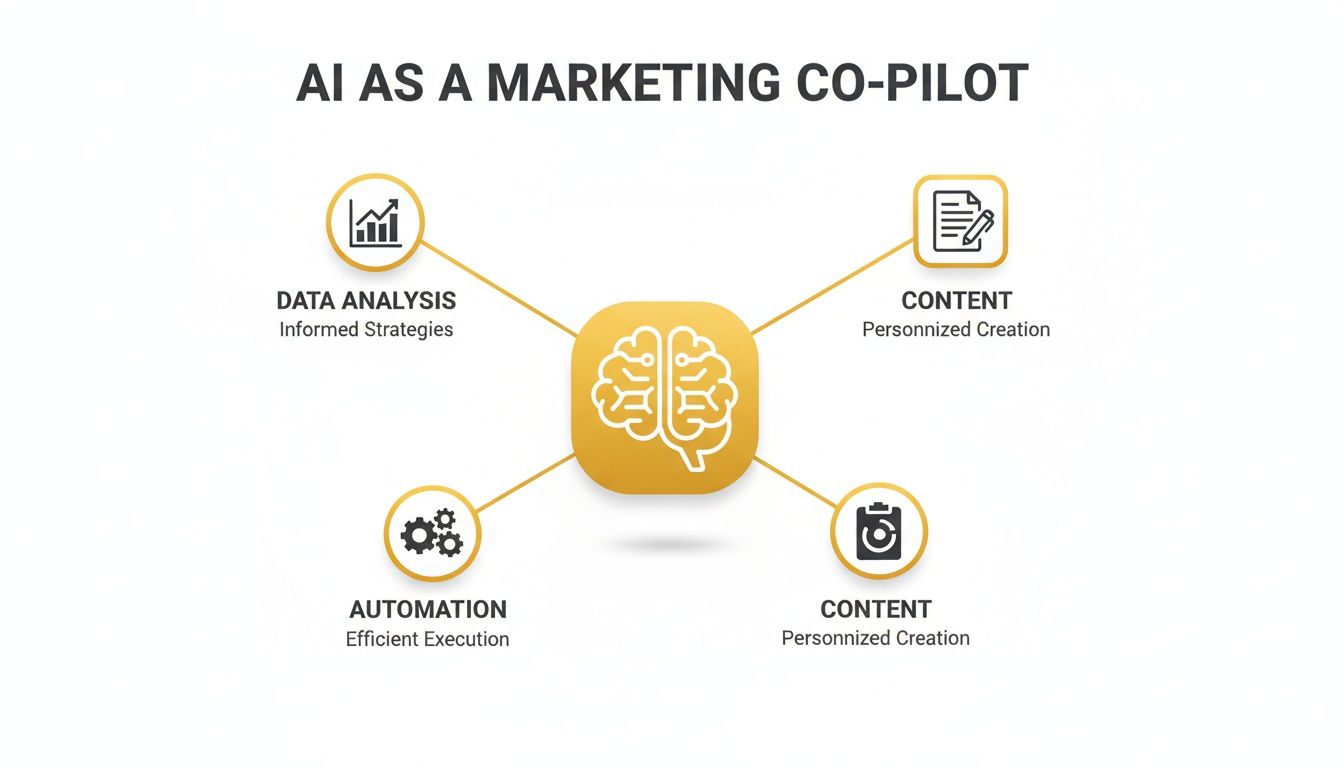
It’s this ability to bridge different functions that makes AI so powerful—it enhances everything from deep-dive analytics to the nitty-gritty of content production.
Let's break down these five key areas.
1. Creative and Content Generation
This is the category that gets all the headlines, and for good reason. These are the artists and writers on your AI team, built to tackle one of marketing’s most relentless challenges: the constant need for fresh, high-quality content.
Generative AI platforms can whip up everything from blog post drafts and snappy social media captions to completely original images for your ad campaigns. For instance, a tool like PhotoMaxi lets you create entire professional-grade photoshoots with consistent AI models, all without ever stepping foot in a studio. This absolutely slashes production time and costs, freeing you up to test more creative ideas than you ever thought possible.
2. Content Optimization and SEO
Creating great content is only half the battle. If no one sees it, did it even happen? That’s where optimization and SEO tools come in. Think of them as the sharp-eyed editors and search strategists who polish your content until it shines, ensuring it reaches the right people and climbs the search rankings.
These tools don't guess; they use data. They'll analyze your article against what's already performing well, suggesting tweaks for keywords, readability, and structure. Picture a tool that gives your blog post an SEO score in real-time, pointing out exactly what to fix.
The real magic of these tools is how they connect creativity with data. They make sure the brilliant content your team produces actually gets discovered by the people it was made for.
3. Analytics and Performance Tracking
Marketing is a numbers game, but drowning in spreadsheets is nobody's idea of a good time. AI analytics tools act as your in-house data scientists, instantly digging through mountains of metrics to find the golden nuggets—the insights that drive real business decisions.
They can tell you which campaigns are working (and which are bombing) in real-time, pinpoint your most valuable customer segments, and even help you see what's coming next. An AI tool might analyze thousands of customer interactions to predict which leads are 80% more likely to convert, helping you focus your efforts where they'll have the biggest impact. You get to make smarter, data-backed moves without needing a PhD in statistics.
Common functions of AI analytics tools include:
- Predictive Lead Scoring: Automatically identifying your hottest prospects.
- Demand Forecasting: Helping you anticipate what customers will want next.
- Real-Time Campaign Adjustment: Tweaking ads on the fly for better results.
4. Personalization and Customer Experience
Today’s customers don’t just want personalization; they expect it. AI makes it possible to deliver those one-on-one experiences at a massive scale. These tools are the personal shoppers and concierges of your marketing stack, crafting unique journeys for every single user.
By analyzing things like browsing history and past purchases, these platforms can serve up hyper-relevant product recommendations, customized emails, and dynamic website content. A classic example is a website chatbot that not only answers a question but also recommends three products based on the conversation. This level of personal attention builds real loyalty and drives conversions through the roof.
5. Automation and Workflow Management
Last but not least, we have the operations managers. AI automation tools are all about eliminating the soul-crushing, repetitive tasks that bog your team down. Their mission is simple: free up your talented humans to focus on strategy and creativity.
These platforms are the glue that holds your tech stack together. For example, you could set up a workflow that automatically posts a new blog to social media, pings your sales team on Slack about a hot new lead, and adds that lead to your CRM—all in a matter of seconds. By taking over the tedious but essential busywork, these tools boost productivity and slash the risk of human error.
To bring it all together, here's a quick summary of how these five pillars support a modern marketing strategy.
The Five Pillars of AI Marketing Tools
| Tool Category | Primary Function | Example Use Case | Key Benefit |
|---|---|---|---|
| Creative Generation | Produces original text, images, and video content. | Generating unique ad visuals with PhotoMaxi. | Reduces production costs and time. |
| Content Optimization | Improves content for search engines and user engagement. | Getting real-time SEO feedback on a blog post. | Increases organic traffic and visibility. |
| Analytics & Tracking | Analyzes data to find insights and predict trends. | Identifying which customer segments will convert. | Enables data-driven decision-making. |
| Personalization | Delivers tailored experiences to individual users. | Showing dynamic product recommendations. | Boosts engagement and conversion rates. |
| Automation | Manages repetitive tasks and connects workflows. | Automatically posting content across channels. | Increases team efficiency and reduces error. |
By understanding how each of these tool categories functions, you can start to piece together an AI-powered marketing engine that's perfectly suited to your team's unique goals and challenges.
Reimagining Visual Content with Generative AI
For as long as anyone can remember, creating high-quality visual content has been a major bottleneck for marketing teams. The process was always the same: pour a significant budget into photographers, models, locations, and gear. This old-school model meant long lead times and very little creative wiggle room, making it a constant struggle to feed the never-ending demand for fresh assets.
Then, generative AI came along and completely flipped the script. What once took weeks of planning and execution can now be done in a few hours from a laptop. This isn't just a small step forward; it's a fundamental shift in how marketing teams produce visuals.
From Photoshoots to Prompting
Think about the old way of launching a campaign for a new product. You'd spend days scouting locations and casting models, then block out a full day for the shoot. After that, it was weeks of post-production. The final bill could easily climb into the tens of thousands for just a handful of approved photos.
Now, let's look at the AI-powered alternative. With AI tools for marketing teams, you can generate an entire campaign's worth of visuals without leaving your desk. Instead of booking a studio, you write a detailed prompt. Instead of hiring a model, you create a consistent AI character that perfectly matches your brand’s vibe.
This approach doesn't just slash costs and turnaround times—its biggest win is scalability. You can churn out hundreds of visual variations for A/B testing ad creative, social media posts, and website banners. That's something that would have been financially out of the question with traditional photography.
Achieving True Creative Scalability
One of the most important breakthroughs in visual AI is the ability to create consistent characters. Early image generators were a mess in this department, producing different faces even when you used the exact same prompt. Today’s platforms, like PhotoMaxi, have cracked this code.
You can design a unique AI model and then drop that same person into countless scenarios—different outfits, different locations, different lighting, you name it. This consistency is a game-changer for building a recognizable brand identity across all your campaigns.
The image below from PhotoMaxi shows just how easy it is to generate endless variations of the same AI model for whatever you need.

This level of control means all your visuals stay perfectly on-brand while still giving you the variety you need to keep your audience from scrolling past.
The momentum here is real. In fact, more than 50% of social media marketers plan to use AI for influencer marketing by 2026, which includes creating and using AI-generated influencers. At the same time, 51% of digital marketers are already using generative AI to create better visuals for their websites and social media.
Practical Use Cases for Generative Visuals
So, what does this actually look like in a day-to-day marketing workflow? The applications are incredibly varied and solve a lot of the common headaches that nearly every team deals with.
Here are a few ways marketing teams are already putting these tools to work:
- Endless Ad Creative: Generate dozens of unique images for a single ad campaign to see which visuals connect best with different audience segments. You can swap out backgrounds, model expressions, and product placements with a few simple text commands.
- Hyper-Personalized Content: Create visuals aimed at specific demographics or locations. An e-commerce brand could show the same jacket on models of different ethnicities or against backdrops of different cities.
- Rapid Social Media Content: The demand for fresh content on platforms like Instagram and TikTok is brutal. AI tools can help you produce a month's worth of on-brand social media visuals in a single afternoon. If you're looking to upgrade your workflow, check out our guide on the best tools for social media content creation.
- Product Photography at Scale: Instead of shipping products around for expensive photoshoots, e-commerce brands can generate high-quality product shots in any setting imaginable. This is especially handy for showing products in lifestyle contexts without all the logistical nightmares.
By tearing down the old barriers of time and money, generative AI finally lets marketing teams move at the speed of digital media. The focus shifts from the logistics of production to the creativity of the campaign itself.
This new reality gives marketers the freedom to be more experimental, more data-driven, and ultimately, far more effective in a very crowded digital space.
Choosing the Right AI Tools for Your Marketing Stack
With a constant flood of new AI apps hitting the market, it’s tempting to chase the latest shiny object. But building an effective marketing stack isn't about collecting the buzziest ai tools for marketing teams—it's about strategically solving your biggest problems. The most sophisticated tool is worthless if it doesn't fit your workflow or fix a real bottleneck.
So, instead of asking, "What's the newest AI tool?" let's start with a better question: "What's our biggest operational headache?" Pinpointing your specific pain points is the most important first step. This means taking a quick, honest look at your team's daily grind to see where you're losing time, money, and creative energy.
Pinpoint Your Biggest Bottlenecks First
Before you even think about watching a product demo, get your team together and figure out what’s actually holding you back. Are you struggling with painfully slow content production, or are your ad creatives just not converting? Is your team drowning in data, or are manual tasks eating up everyone's time?
Here are some of the most common hurdles marketing teams face:
- Slow Creative Output: Your team can't produce enough quality visuals or copy to keep up with the demands of all your campaigns.
- Ineffective Ad Performance: Your paid campaigns are stuck with low engagement and sky-high customer acquisition costs.
- Data Overload: You’ve got tons of analytics but no time or expertise to pull out insights you can actually act on.
- Repetitive Manual Tasks: Team members spend way too much time on admin work like scheduling social posts or updating weekly reports.
Once you’ve nailed down your top one or two bottlenecks, then you can start looking for tools designed to fix them. For instance, if creating visual content is your main roadblock, you can dive into the best AI tools for content creation to find a platform that tackles that exact issue.
Evaluate Tools Against Key Criteria
After you've got a shortlist of tools that solve your specific problem, it's time to run them through a practical checklist. A tool that looks amazing on paper can quickly turn into a massive headache if it doesn't mesh with your team's existing tech and skills.
The right AI tool should feel like a natural extension of your team, not another complicated system to manage. Focus on seamless integration and user-friendliness to ensure widespread adoption and a positive return on investment.
Here are the four essential criteria to use when you're making a final call:
- Seamless Integration: How well does the tool play with the platforms you already live in every day? If it can't connect to your CRM, social media scheduler, or project management software, you’re just creating more manual work.
- User-Friendliness: Can your team jump in and start using it without weeks of training? A steep learning curve can kill adoption before you ever see a return. Look for an intuitive interface and solid customer support.
- Scalability and Growth: Will this tool grow with you? Think about whether the platform can handle more users, a bigger workload, and greater complexity as your team and business expand.
- Transparent Pricing: Is the pricing model clear, predictable, and fair for the value you expect to get? Steer clear of tools with hidden fees or confusing credit systems that make it impossible to budget.
By following this simple framework—diagnosing your pain points and then vetting solutions against these core criteria—you shift from being a trend-chaser to a strategic problem-solver. It’s an approach that ensures you invest in tech that delivers real, measurable value from day one.
How to Measure the ROI of Your AI Investment
Bringing a new AI tool into your marketing stack is exciting, but sooner or later, you'll have to answer the big question: is it actually worth the money? Justifying the budget for a new platform isn't about gut feelings or cool features; it’s about showing a real, tangible return on investment (ROI).
The good news is that measuring the impact of AI isn't as mysterious as it sounds. The trick is to draw a straight line from what the tool does to a business metric that matters.
Think of it like hiring a new team member. You wouldn't bring someone on without defining their role and how you'll measure their success. The exact same logic applies here. Every AI tool has a job to do, and your goal is to track how well it's doing that job in a way that affects the bottom line. This means going from "it saves us time" to "it saved us 20 hours this month, which translates to $1,500 in reclaimed productivity."
And marketers are already seeing these kinds of results. Recent AI marketing statistics show that 81% of digital marketers credit AI with boosting brand awareness and sales. What's more, 75% of US marketers say AI helps cut down on organizational costs, while SEO-focused teams have seen organic traffic jump by an average of 24% with AI-driven strategies. You can find more detailed stats on AI in marketing at seo.com.

Connecting AI Functions to Core KPIs
The first step is to match your AI tools to specific key performance indicators (KPIs). A content optimization tool and a generative visual platform will have completely different yardsticks for success.
Let's break down a few common scenarios based on the type of AI you're using.
For any tool that handles repetitive work, the most direct ROI comes from pure productivity gains.
- Metric: Time Saved Per Task
- Formula: (Hours Saved Weekly) x (Average Team Member Hourly Rate) x (52 Weeks) = Annual Productivity Savings
- Example: If an AI automation tool frees up your social media manager for 5 hours a week and their blended hourly rate is $40, that’s an annual saving of $10,400. Simple as that.
Measuring Creative and Content Generation Tools
When you're using platforms like PhotoMaxi to generate visuals, you can measure the ROI in a few compelling ways. The most obvious win is the direct cost savings compared to traditional production methods.
ROI for creative AI isn't just about cutting costs; it's about unlocking performance gains that were previously too expensive or time-consuming to achieve. It allows you to test more, learn faster, and ultimately drive better results.
Start by calculating the hard budget savings. Just line up what you used to spend with what you spend now.
Example Production Budget Comparison
| Cost Item | Traditional Photoshoot | AI Generation (PhotoMaxi) |
|---|---|---|
| Photographer/Studio | $5,000 | $0 |
| Model Fees | $2,000 | $0 |
| Location/Permits | $1,500 | $0 |
| AI Subscription | $0 | $100/month |
| Total Cost | $8,500 | $100 |
But don't stop at direct savings. Look at performance. Did the endless variety of AI-generated ad creatives lead to a lower Cost Per Acquisition (CPA)? A 15% reduction in CPA on a $20,000 ad spend is another $3,000 straight back into your budget.
Tracking Optimization and Analytics Tools
For tools built to improve SEO or boost conversion rates, the ROI is tied directly to traffic and revenue growth. An AI-powered SEO tool that helps you rank for more valuable keywords is driving measurable organic traffic, and that traffic has a clear dollar value.
Here are the KPIs to keep a close eye on:
- Lift in Conversion Rate: If an AI personalization tool bumps your landing page conversion rate from 2% to 2.5% on 50,000 visitors with an average order value of $100, that’s an extra $25,000 in additional revenue.
- Increased Organic Traffic: Use a traffic value calculator to assign a dollar amount to the new visitors your AI-optimized content is bringing in. It’s a powerful way to show the value of your content efforts.
- Improved Lead Quality: An AI analytics tool that helps score and qualify leads can make your sales team dramatically more effective. Pushing their close rate from 20% to 25% means more revenue from the exact same number of leads.
By tying every tool to a specific, measurable outcome—whether it's saving money, boosting productivity, or driving direct revenue—you build an undeniable business case. This approach reframes AI from a simple tech expense into a strategic investment that is clearly pushing the business forward.
Common Questions About AI in Marketing
Bringing any new technology into your workflow is going to spark some questions. And when that technology is AI, those questions can feel pretty significant. Marketing teams are rightfully curious about how these tools will change their day-to-day work, how they'll keep their brand standards intact, and what this all means for their careers.
This section gets straight to the point, tackling the most common hesitations people have. We'll cover everything from job security to brand consistency with direct, practical answers to help you feel confident about your AI strategy.
Will AI Tools Replace Our Marketing Jobs?
This is the big one, isn't it? The good news is that the reality is far less scary than the headlines. AI tools are built to be collaborators, not replacements. They’re fantastic at handling the repetitive, data-heavy, and frankly, soul-crushing tasks that eat up so much of a marketer's day. This frees you up to focus on the work that actually requires a human touch: strategy, creative direction, and building real relationships with customers.
Think of AI as the most powerful assistant you've ever had. It can knock out a dozen first drafts or analyze a mountain of data in the time it takes you to grab a coffee. This doesn't make the human marketer obsolete; it makes them more strategic. Your role shifts to guiding the AI, interpreting what it produces, and making the final creative calls. The teams that lean into this find they can accomplish more than ever before, not that they're no longer needed.
Your job will not be taken by AI. It will be taken by a person who knows how to use AI.
- Christina Inge, Harvard Division of Continuing Education Instructor
The key is to see this as a skill evolution. Marketers who learn to effectively direct AI tools become incredibly valuable because they can deliver results at a scale and speed that was simply impossible before.
How Do We Keep AI-Generated Content On-Brand?
This is a completely valid concern. Brand consistency is everything, and the last thing you want is AI-generated content that dilutes your message or confuses your audience. Thankfully, modern AI tools are designed with this exact problem in mind, giving you the controls you need to keep everything aligned.
For text-generating tools, you can feed them detailed brand voice guides and style examples to make sure the tone and language are a perfect match. When it comes to visual tools like PhotoMaxi, it's all about features that lock in consistency.
Here’s how you can maintain your brand’s visual identity with AI:
- Use Consistent Models: You can create a specific AI-generated model or character and then use that exact same person across thousands of different images.
- Define Your Style: Get specific in your prompts. Call out your exact brand colors, preferred aesthetic (like "minimalist" or "vibrant"), and even the types of environments you want to see.
- Establish Brand Kits: Many platforms now let you save your brand assets—logos, fonts, color palettes—so you can apply them easily to anything you create.
The best way to think about it is this: the AI is a production tool, but you are still the creative director. You set the brand rules, and then you review and refine the output to ensure every single piece feels like it came from you.
What Is the Best Way to Start Implementing AI?
The absolute best way to start is to go small. Don't try to roll out a dozen new tools at once—that's a surefire recipe for overwhelming your team and getting zero buy-in.
Instead, start by zeroing in on your single biggest bottleneck. What’s the one task that constantly slows your team down? Is it writing endless social media captions? Coming up with fresh ad images every week? Digging through campaign data? Once you have your target, find one user-friendly AI tool that's built to solve that specific problem.
Here’s a simple, three-step process to get going:
- Pinpoint a Bottleneck: Huddle with your team and agree on the one task that’s the biggest time-sink.
- Run a Pilot Project: Pick one tool and sign up for a free trial or a basic plan. Give it a small, specific project to see how it performs and how easy it is to use.
- Measure and Expand: Track the results. Did you save 10 hours of work? Did ad engagement jump by 15%? Use that clear win to build a case for bringing AI into other parts of your workflow.
This targeted approach gives you an early, measurable return on your investment, which makes it much easier to get the rest of the team excited about what's next.
Are There Ethical Concerns with Using AI-Generated Content?
Yes, and it’s important to address them head-on. The two guiding principles here are transparency and responsible usage. As AI becomes more common in marketing, your audience will expect you to be honest about how you're using it. The goal is always to build trust, not to deceive.
For example, if you're using AI-generated models in your ads, it's best practice to avoid creating content that's misleading or implies a real person is endorsing your product when they aren't. For written content, the main ethical line is to ensure everything is accurate and original. Always have a human in the loop to review and fact-check AI-generated text before it goes live. This maintains your brand's integrity and your audience's trust.
Ready to finally break through your visual content bottlenecks and start creating at scale? With PhotoMaxi, you can generate thousands of on-brand, studio-quality images with consistent AI models in just a few hours. Stop waiting on expensive, time-consuming photoshoots and start creating at the speed of your ideas. Explore PhotoMaxi and start your free trial today.
Related Articles


Ready to Create Amazing AI Photos?
Join thousands of creators using PhotoMaxi to generate stunning AI-powered images and videos.
Get Started Free