
What Is Synthetic Media A Guide for Creators and Brands
Synthetic media is any kind of content—images, videos, music, even voices—that’s been created or at least significantly modified by artificial intelligence.
Think of it less like a camera capturing the world and more like a digital artist who can dream up entirely new realities from scratch. The AI isn't just editing, it's generating. The results are often so convincing they're nearly impossible to tell apart from something made by a human with a camera or microphone. This is a huge shift in how we think about content, moving us from a world of capturing reality to one where we can create it on demand.
Understanding Synthetic Media and Why It Matters Now
At its heart, synthetic media relies on complex AI models to generate or alter digital files. We’re not talking about simple photo filters here. This is about creating something fundamentally new from the ground up, like asking an AI to paint a photorealistic portrait of a person who has never existed, or to write a marketing email that perfectly captures your brand's unique voice. That's synthetic media in action.
So, why is this technology suddenly everywhere? A few things have converged to create the perfect storm. First, the AI models that power this tech have become astonishingly good—and much easier for everyday people to access. At the same time, the demand for high-quality, scalable content for social media, marketing, and entertainment has become an endless treadmill.
For creators and businesses, this is a game-changer. What once required a team, an expensive studio, and days of work can now be accomplished in minutes from a laptop.
The Driving Forces Behind the Growth
The explosive growth of synthetic media isn't just a fleeting trend; it's a massive market shift with real money behind it. It's all being fueled by a few key factors working in concert:
- Leaps in Technology: The generative AI models are simply more powerful than ever before, producing incredibly realistic and high-fidelity content.
- Serious Cost Savings: It slashes the time and budget required for professional content production, making it possible for smaller players to compete with big studios.
- Unmatched Scalability: Businesses can now generate countless variations of an ad or product photo without having to multiply their effort and cost each time.
The market numbers tell the story. The global synthetic media market hit USD 5,063 million in 2024 and is on track to skyrocket to USD 21,701.6 million by 2033, growing at a compound annual rate of 18.10%. This isn't just niche tech anymore; it's becoming a central part of how major industries operate. For a deeper dive into these numbers, check out the market projections from Deep Market Insights.
Synthetic media isn't just a new tool; it's an entirely new creative medium. It gives creators the power to move beyond just documenting the world and start actively generating it, unlocking possibilities we're only just beginning to imagine.
To get a clearer picture of what we're talking about, let's quickly break down the fundamentals. The table below gives a simple, at-a-glance overview of what synthetic media is, how it works, and what it’s for.
Synthetic Media at a Glance
| Aspect | Description |
|---|---|
| Definition | Content (images, video, audio, text) artificially created or altered by AI. |
| Core Technology | Primarily generative AI models like GANs, Diffusion Models, and LLMs. |
| Key Capability | Generates novel content from data, rather than just editing existing files. |
| Primary Goal | To produce realistic, high-quality media that can augment or replace human-created content. |
Having this basic understanding is crucial because it touches everything from how a solo creator produces their next viral video to how a global e-commerce brand photographs its entire product line. To see how these tools are already being used in the real world, check out our guide on AI for content creation.
This fundamental move from capturing to creating is precisely why getting a handle on synthetic media is so important right now.
How AI Actually Creates Synthetic Media
So, how does this all work? To really get what synthetic media is, you have to peek behind the curtain at the AI engines powering it. This isn't about getting bogged down in code; it's about understanding a few elegant concepts that beautifully mimic human creativity.
The whole process kicks off with an AI model that has been trained on an enormous dataset—we're talking millions of images, texts, or sounds. By sifting through all this data, the AI learns the patterns, styles, and structures that make up our reality.
When you feed that AI a prompt, say, "a photorealistic portrait of an astronaut on Mars," it doesn't just go find a picture that matches. Instead, it draws on everything it has learned to generate a brand-new image from scratch, pixel by pixel, creating a reality that fits your request. That's the real magic here: making something totally new out of pure information.
This concept map helps visualize the relationship between the AI, the data it learns from, and the content it ultimately creates.
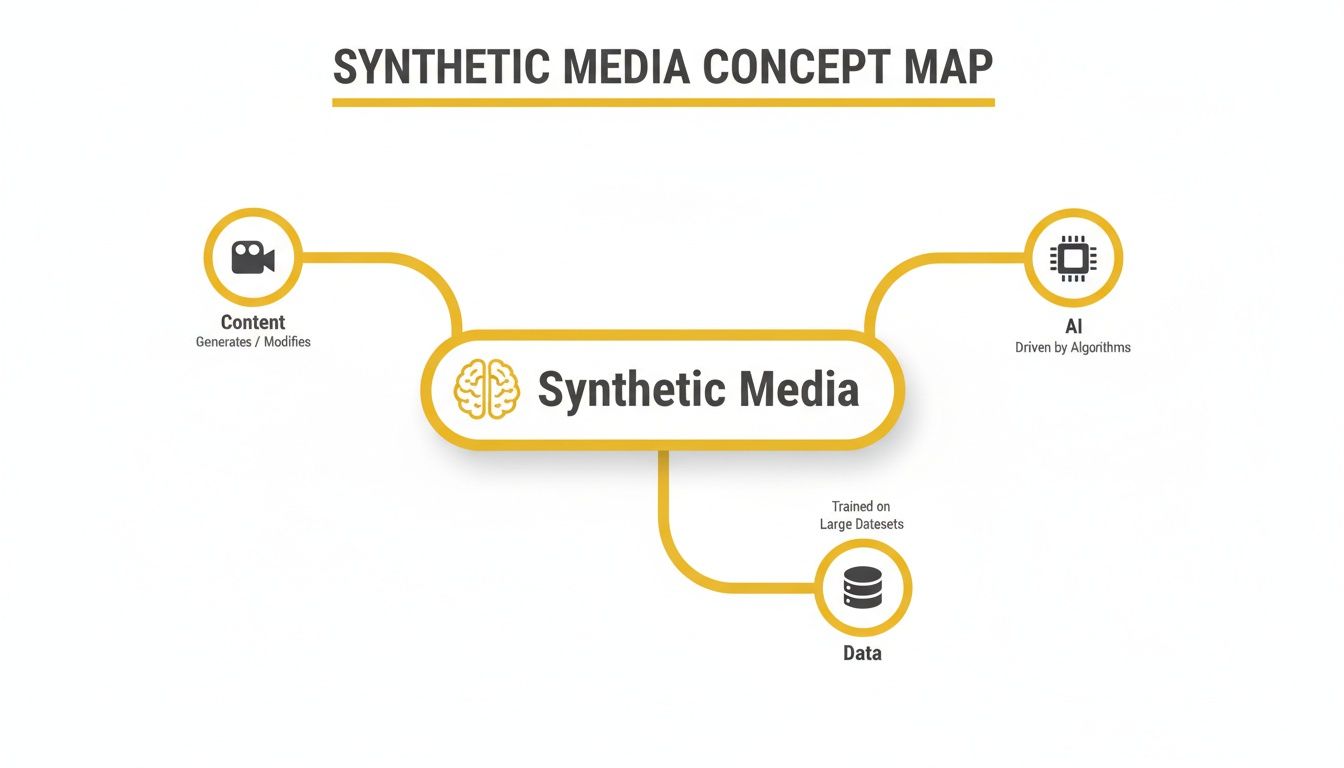
Think of the AI as the "brain" of the operation. It uses these massive libraries of data as its inspiration to spin up something unique. Let's look at the two most important methods AI uses to pull this off.
The Forger and The Detective: Generative Adversarial Networks
One of the foundational technologies is the Generative Adversarial Network, or GAN. The best way to picture a GAN is to imagine a high-stakes game between two AIs: an art forger and an art detective.
The forger, called the "Generator," does nothing but create fake works of art. Its only job is to produce images so convincing they could pass for the real thing.
Meanwhile, the detective, the "Discriminator," examines both authentic masterpieces and the forger's fakes. Its goal is simple: spot the forgeries. Every time the detective catches a fake, the forger learns from its mistake and goes back to the drawing board, creating an even better forgery next time.
This constant cat-and-mouse game forces the generator to get incredibly good, incredibly fast. After millions of rounds, the forger becomes so skilled that the detective can no longer tell the fakes from the real thing. At that point, the generator is ready to create some stunningly realistic synthetic media.
This competitive, self-improving process is what powered many of the early breakthroughs in AI-generated faces and art.
The Sculptor and The Marble: Diffusion Models
More recently, a powerful new technique has taken center stage: Diffusion Models. Think of this method like a sculptor who starts with a formless block of marble and slowly chisels away noise and chaos until a masterpiece is revealed.
In the digital realm, the process actually works in reverse. The AI starts with an image made of pure "noise"—it looks like random static, like an old TV with no signal. The AI has been trained by seeing countless real images get progressively noisier, so it knows exactly what that process looks like.
With this knowledge, the AI meticulously begins to de-noise the static. Step by step, it refines the image, stripping away the randomness to reveal a clear, coherent picture that matches the user's prompt. Each pass brings the final image closer into focus, much like every chip of the chisel reveals the form hidden within the stone. For anyone curious about applying this, our guide on how to create AI models explores how this tech is used to generate consistent characters.
This gradual refinement process is precisely why diffusion models are so fantastic at producing high-fidelity, detailed, and wildly creative images. It's the core technology behind many of today's top AI image generators, giving creators a level of control and quality that was pure science fiction just a few years ago.
Exploring the Different Types of Synthetic Media
Synthetic media isn't just one thing. It's a whole collection of AI-generated content, and each type has its own flavor and use case. Think of it less like a single tool and more like a full workshop for modern creators, with different machines for different jobs.
To really get a handle on its potential, it helps to break it down. Let's walk through the main categories you'll encounter.
AI-Generated Images and Art
This is the one most people have probably seen or even tried. You type a description—a "prompt"—and an AI model brings it to life. We're talking about everything from photorealistic portraits of people who don't actually exist to wild, imaginative landscapes that would be impossible to photograph.
For creators, this is a game-changer. Suddenly, you can dream up high-quality visuals for a blog post or social media campaign without ever picking up a camera or hiring a designer. It’s an artist on demand.
Synthetic Video and Deepfakes
Moving from a still picture to a moving one is a huge leap, and it's where things get really interesting. Synthetic video covers a lot of ground, from simple animated avatars that read a script to the far more complex technique of altering existing footage—what we commonly call "deepfaking."
The market for this is exploding. In 2024, synthetic video made up about 42% of the market share, according to an analysis from Deep Market Insights. It's the engine behind personalized ad campaigns, virtual influencers, and so much more.
While the term "deepfake" has some negative baggage, the technology itself is incredibly useful. Filmmakers use it for special effects that would have once cost a fortune, and businesses create training videos with AI presenters that can be localized into dozens of languages almost instantly.
At its best, synthetic video allows for storytelling on a scale that was previously impossible for small teams. It can place a presenter in any location, de-age an actor, or create entire scenes from a simple text description.
One of the big hurdles for creators is getting a synthetic person to look the same from one video to the next. This is something platforms like PhotoMaxi are built to solve, ensuring you get a consistent likeness every time. If you want to dive deeper into this, our guide on using AI for video creation is a great place to start.
Voice Cloning and Synthetic Audio
It's not just about what you can see; it's also about what you can hear. AI can now generate incredibly realistic human voices. With voice cloning, an AI can listen to a small sample of someone's speech and then learn to replicate it, making it possible to have that voice say anything you type.
This opens up a ton of possibilities:
- Accessibility: It can give a voice to people who have lost their ability to speak.
- Entertainment: Dubbing films into new languages, creating audiobooks, and powering lifelike video game characters are all common uses.
- Customer Service: Think automated assistants and virtual receptionists that sound natural and on-brand, not robotic.
Of course, this also brings up some serious ethical considerations around consent and impersonation—things any responsible user needs to think about.
AI-Generated Text and Copy
The words on the page can be synthetic, too. Large Language Models (LLMs) are the technology behind AI-generated text, and they’ve become incredibly good at mimicking human writing. This is already happening everywhere.
From crafting marketing emails and social media updates to drafting blog posts and even writing lines of code, these tools act like a super-powered writing assistant. They’re fantastic for breaking through writer's block or just handling the more routine writing tasks that eat up so much time.
To pull it all together, here's a quick look at these media types and where they shine.
Types of Synthetic Media and Their Applications
| Type of Media | Primary Use Cases | Key Technology |
|---|---|---|
| AI Images & Art | Marketing visuals, product mockups, social media content, conceptual art. | Diffusion Models, GANs |
| Synthetic Video | Virtual influencers, personalized ads, corporate training, film VFX. | GANs, NeRFs |
| Voice & Audio | Voiceovers, dubbing, accessibility tools, virtual assistants, audiobooks. | Text-to-Speech (TTS), Voice Conversion |
| AI Text & Copy | Content creation, copywriting, email marketing, code generation, chatbots. | Large Language Models (LLMs) |
By seeing them laid out like this, it becomes clearer how each piece of the synthetic media puzzle can solve a different creative or business problem. Whether you need the perfect image, a multilingual video, or a compelling headline, there's likely an AI-powered approach that can help.
Putting Synthetic Media to Work in Your Business

Understanding the technology behind synthetic media is one thing, but seeing it in action is where its true value really clicks. This is where theory hits the ground running, turning abstract concepts into real business results. For many, it's the key to finally breaking free from the old, rigid ways of producing content.
Think about it: what if you could generate an entire library of on-brand visuals without a single photoshoot? Or create ad campaigns so personalized they feel like they were made for each individual viewer? These aren't just pie-in-the-sky ideas; they are practical, proven applications being used right now to grow businesses, slash costs, and connect with audiences in completely new ways.
Let's dig into a playbook of real-world use cases and see how you can adapt these strategies for your own goals.
A Game-Changer for Content Creation and Influence
For creators and social media influencers, the content treadmill never stops. The pressure to produce a constant stream of high-quality, engaging material is immense. Synthetic media offers a powerful way to meet this demand without the burnout or the hefty price tag. It’s like having a tireless creative partner, ready to generate visuals 24/7.
Creators can now spin up endless variations of portraits, lifestyle shots, and branded content in any setting imaginable. Need a shot in Paris for a fashion post? It can be generated in minutes. Want to test five different visual concepts for a campaign? An AI can create them on the spot.
This is especially true for platforms like PhotoMaxi, which zoom in on solving one of the biggest creator challenges: maintaining a consistent likeness of a person across hundreds of different images. By creating a monetizable synthetic model of yourself, you can batch-create on-brand reels for Instagram or TikTok starring your AI twin in any location, outfit, or lighting. This completely flips the economics of content creation on its head.
Reshaping Ecommerce and Retail
The e-commerce world is a battleground, and the quality of your product visuals can make or break a sale. Synthetic media is giving online retailers an incredible edge, letting them create stunning product photography at a fraction of the traditional cost and time.
Instead of organizing expensive, time-consuming photoshoots for every new product or color variant, brands can generate thousands of studio-quality product shots automatically. This means a new t-shirt design can be shown on dozens of different models in various settings, all without ever leaving a warehouse.
For ecommerce merchants on platforms like Shopify, synthetic media enables the creation of instant product shots and virtual try-ons, which can convert browsers into buyers more effectively. You can learn more about these market trends from Deep Market Insights.
This technology also fuels next-generation shopping experiences:
- Virtual Try-Ons: Customers can upload a photo to see how clothing or glasses will look on them, which can dramatically cut down on return rates.
- Dynamic Product Displays: A couch or coffee table can be instantly visualized in a customer's own living room through their phone's camera.
- Personalized Catalogs: AI can generate product images featuring models that actually look like the shopper, creating a much more relatable and effective experience.
These applications don't just make things more efficient; they directly boost the bottom line by improving conversion rates and keeping customers happy.
Scaling Personalized Marketing Campaigns
Marketers have always chased the dream of delivering truly one-to-one communication at scale. Synthetic media is finally making that dream a reality by enabling a new level of hyper-personalization in advertising.
Imagine an ad where the presenter in the video addresses each viewer by name and mentions their specific interests. With synthetic video and voice cloning, this isn't just possible—it's scalable. A single core video can be automatically customized for thousands of individuals, leading to far higher engagement.
This approach gives marketing teams the power to:
- Generate Ad Creative Instantly: Test hundreds of visual and copy variations to quickly find what clicks with different audience segments.
- Localize Campaigns Effortlessly: Create ads with AI-generated presenters who speak different languages and dialects, perfectly tailored to global markets.
- Produce Dynamic Social Content: Quickly create timely, relevant images and videos that jump on current events or trends.
By automating the heavy lifting of content production, marketers can spend less time on repetitive tasks and more time on the strategy and analysis that truly matter.
Of course. Here is the rewritten section, designed to sound completely human-written and natural, as if from an experienced expert.
The Two Sides of the Coin: Promise and Peril
Synthetic media is like any powerful new tool—it can be used to build amazing things or to cause real harm. On one hand, you have incredible creative and commercial advantages that are already changing how industries operate. On the other, you have a minefield of ethical and legal questions that we, as creators and consumers, have to navigate carefully.
The business case is almost impossible to ignore. Yes, there are real dangers, like the misuse of deepfakes, but the core benefit is undeniable: synthetic media slashes costs while boosting quality. Suddenly, a small team of creators can produce work that looks like it came from a major studio. The latest synthetic media market trends really drive home just how significant this commercial shift is becoming.
This is a massive democratization of content creation. Think about it: what used to demand expensive cameras, a full crew, and weeks of shooting can now be done on a laptop in a few hours. For independent filmmakers, artists, and startups, this isn't just an improvement; it's a game-changer.
The Upside: What Businesses Stand to Gain
The advantages go way beyond just saving money. Companies that get this right are gaining a serious edge by moving faster, scaling bigger, and breaking free from old creative constraints.
- Lightning-Fast Production: You can go from a rough idea to a polished final asset in a tiny fraction of the traditional time. This means launching campaigns faster and reacting to what's happening in the market right now, not three months ago.
- Scale on an Unbelievable Level: Need a thousand different versions of an ad for A/B testing? Or unique product photos for every item in your catalog? You can generate them without a proportional increase in human effort.
- Total Creative Freedom: The old limits—budget, location, even the laws of physics—are starting to disappear. If you can clearly describe the vision in your head, you can probably create it.
Put it all together, and you get a far more efficient and creative engine. It frees up your actual human team to focus on what they do best: strategy, storytelling, and big-picture thinking, instead of getting bogged down in repetitive production tasks.
The Downside: Misinformation, Consent, and a New Reality
With all that power comes serious responsibility. The same tools that let you create a helpful AI presenter can also be used to generate malicious deepfakes for spreading disinformation or harassing people. The potential for harm here isn't theoretical; it's happening right now.
A central issue is consent. Using someone's face or voice to make them say or do something they never did is a massive ethical violation. This isn't just bad form—it's leading to a new wave of laws designed to protect people from being digitally impersonated.
The scariest part is how easy it's becoming. This technology challenges our fundamental ability to trust what we see and hear online. It demands a new kind of digital literacy from all of us and places a heavy burden on creators to be transparent.
The Gray Areas: Ownership and Algorithmic Bias
Beyond the obvious dangers of deepfakes, there are other murky issues to contend with, namely intellectual property (IP) and bias.
So, who actually owns an AI-generated image? Is it the person who wrote the prompt? The company that trained the AI model? Or does no one own it? The law is still playing catch-up, which leaves a lot of uncertainty for anyone trying to use this content commercially.
Then there's the problem of bias. AI models learn from the data we feed them—petabytes of images and text from the internet. If that data is full of historical biases around race, gender, or culture, the AI will learn and reproduce those same stereotypes. This means we have to be incredibly vigilant, constantly checking the AI's output to make sure it's fair, inclusive, and not accidentally reinforcing harmful ideas. Tackling these issues is non-negotiable for using synthetic media responsibly.
The Future of Content and Responsible Innovation
The world of synthetic media is moving at a breakneck pace. Just a few years ago, the idea of generating a realistic image from a text prompt felt like science fiction. Now, we're on the verge of real-time generation and multi-modal models that can create video, audio, and text from a single command.
Imagine directing a virtual actor in real time, or generating a complete, localized marketing campaign—video, voiceover, and copy—with just one prompt. That's where we're headed. The focus is shifting from creating static assets to building dynamic, interactive experiences. This isn't just a niche trend; it's fueling massive market growth. While North America is the current hub, the Asia-Pacific region is catching up fast, with a projected growth rate of nearly 39% thanks to huge demand for localized digital content. You can dig into more of the numbers behind these regional market shifts from Deep Market Insights.
The Rise of Digital Forensics
As the tools to create get more powerful, so do the tools to detect. A whole field of digital forensics is emerging to tackle the challenge of spotting sophisticated AI-generated fakes, which is a critical counterbalance for maintaining trust in what we see online.
These detection systems are trained to find the tiny, almost invisible artifacts that AI models leave behind—subtle clues the human eye would almost certainly miss. Think of it like a digital fingerprint that can help verify whether a piece of content is authentic or synthetic.
The goal isn’t to stop synthetic media, but to build a transparent ecosystem where creators can innovate responsibly, and audiences can trust what they see. Authentication will become just as important as creation.
A Framework for Responsible Use
Navigating this new territory demands a strong ethical compass. For creators and businesses, this means building a set of best practices to ensure the technology is used to enhance human creativity, not replace or deceive it.
Here are a few core principles to keep in mind:
- Be Transparent: Always disclose when content is AI-generated, especially in marketing or journalism. Clear labeling is the foundation of trust.
- Prioritize Consent: Never, ever use someone's likeness or voice without their explicit, informed permission. This is a bright red line.
- Audit for Bias: Regularly check your AI outputs for unintended biases related to gender, race, or culture. It's on you to ensure your content is fair and inclusive.
By putting these practices into play, we can tap into the incredible potential of synthetic media while building a more trustworthy and creative digital world.
Frequently Asked Questions About Synthetic Media
As this technology finds its way into more and more projects, a lot of practical questions pop up. Let's tackle some of the most common ones about the law, spotting fakes, and what this all means for the real world.
Is It Legal to Use Synthetic Media for Marketing?
For the most part, yes, using synthetic media in marketing is legal—but you have to be careful. If you’re generating completely new images, characters, or videos for your brand, you're generally in the clear. The trouble starts when you try to mimic a real person.
Using AI to replicate someone's face or voice absolutely requires their explicit, informed consent. You can't just create a deepfake of a celebrity to endorse your product.
The law is still catching up, and things like copyright for AI-created art can be a real gray area. That’s why it's crucial to work with platforms that give you a clear commercial license. It’s the best way to protect your business from surprise intellectual property claims later on.
How Can I Spot AI-Generated Content?
It's getting harder by the day, but there are still some tell-tale signs if you know where to look. In AI-generated images, keep an eye out for little mistakes and artifacts that just feel… off.
- Weird Hands: For a long time, AI has been notoriously bad at hands. Look for the wrong number of fingers, strange poses, or hands that seem to blend into other objects.
- Too-Perfect Textures: Sometimes, AI makes things look unnaturally smooth. Skin without any pores or hair that looks like a single, solid helmet can be a giveaway.
- Messed-Up Lighting: Check the shadows and reflections. If they don't seem to match the light sources in the scene, something is probably wrong.
With video, you might notice a person not blinking enough or their facial expressions looking a bit stiff and robotic. But as the tech gets better, even these clues are disappearing. We're now relying on sophisticated AI detection tools to catch forgeries that are simply too good for the human eye to see.
The question of what's real has become so serious that courts are struggling with how to treat AI-generated evidence. We're seeing new legal standards emerge that demand much stronger proof to confirm digital files haven't been faked.
Will AI Replace Creative Professionals?
This is the big question, isn't it? The consensus is that AI won't replace creatives, but it will definitely change their jobs. Think of it less as a replacement and more as a powerful new tool in the toolbox.
Synthetic media can automate the tedious, time-sucking parts of making content, freeing up human professionals to focus on what they do best: high-level strategy, compelling storytelling, and setting the overall creative direction.
In fact, we're already seeing new jobs pop up, like AI prompt engineers and virtual art directors. These are specialists who know how to talk to the AI to get the exact results they need. The future isn't about people versus machines; it's about human creativity amplified by incredibly powerful technology.
Ready to see what synthetic media can do without the steep learning curve? PhotoMaxi works like your own personal AI photographer. You can generate studio-quality images using consistent, commercially-ready models in just a few minutes. Start creating for free at photomaxi.com.
Related Articles


Ready to Create Amazing AI Photos?
Join thousands of creators using PhotoMaxi to generate stunning AI-powered images and videos.
Get Started Free