Ai for photography: Elevate Your Shots with AI-Driven Creativity
Imagine having a fully-equipped photo studio at your command, ready to bring any creative vision to life in just a few minutes. That's the new reality with AI for photography. This isn't just about another filter or a simple editing trick; it's a fundamental shift in how we create images, turning technology into a powerful creative partner.
The New Revolution in Digital Photography
Traditional photography has always been a craft. Think of it like building an intricate ship in a bottle—it demands immense skill, specialized gear, and a whole lot of patience. From setting up the perfect lighting to spending hours in post-production, the process is meticulous and time-consuming. While that traditional workflow has its place, it often puts up major roadblocks for creators and businesses.
AI for photography, on the other hand, is more like having a 3D printer for your imagination. It gives you the power to generate countless variations of an idea almost instantly, freeing you from the physical limits of a studio, the availability of models, or the need to scout locations. This new way of working directly tackles the pain points that have frustrated the creative industry for years.
Overcoming Traditional Creative Hurdles
For decades, creating high-quality images meant investing a ton of resources. The costs and time involved often stifled creative exploration. AI flips that script by offering a much more flexible and accessible way to get things done.
Here are the key problems AI helps solve:
- High Production Costs: It cuts out the need for expensive photoshoots, model fees, location rentals, and gear. A single person can now produce commercial-quality visuals without a six-figure budget.
- Creative Bottlenecks: You can generate new concepts, styles, and compositions on the fly without waiting on a whole team. This speed means you can experiment rapidly and find the perfect visual direction in hours, not weeks.
- Logistical Complexity: Forget about the nightmare of coordinating schedules, shipping products across the country for a shoot, or traveling to specific locations. AI lets you create an image of a product on a beach in Bali or a person in a futuristic city, all from your desk.
AI acts as a collaborative partner, making professional-grade photography accessible to everyone. It's not here to replace artistic skill but to amplify it, giving creators the tools to execute their vision without the usual roadblocks.
A Partnership Between Human and Machine
This shift positions AI as a tool that empowers, not replaces, human creativity. It handles the technical heavy lifting—generating backgrounds, adjusting lighting, and creating variations—which frees you up to focus on what really matters: the story, the brand, and the artistic direction.
The result is a workflow that's more efficient, cost-effective, and creatively liberating. This guide will break down exactly how this technology works and show you how to start using it in your own creative process.
Understanding How AI Photography Works
To really get what AI for photography is all about, it helps to peek behind the curtain. The tech itself is incredibly complex, but the core ideas are actually quite straightforward. At its heart, an AI model learns to create images by analyzing millions of existing photos. It picks up on patterns, styles, objects, and lighting—much like a human artist studies the great masters to learn their craft. This training is what lets it generate entirely new, photorealistic visuals from something as simple as a text description.
Instead of capturing light through a lens, these systems build images from the ground up, pixel by pixel, based on what they've learned. The two main technologies you'll hear about are Generative Adversarial Networks (GANs) and Diffusion Models. They take different routes but arrive at the same destination: creating a vibrant, detailed picture from pure data.
The Artist and the Critic: Generative Adversarial Networks
Think of a painter and a very picky art critic working together. The painter (the Generator) creates an image from scratch. The critic (the Discriminator) then examines it and decides if it looks real or like a cheap fake.
- At first, the painter’s work is messy and unconvincing.
- The critic easily spots the flaws and sends the painter back to the easel.
- With every piece of feedback, the painter gets a little bit better.
- Eventually, the painter becomes so good that the critic can no longer tell the difference between the AI's creation and an actual photograph.
This back-and-forth competition is the magic of a GAN. Through thousands of these rapid-fire cycles, the AI hones its ability to produce images that are virtually indistinguishable from reality, nailing everything from subtle lighting to complex textures.
The Sculptor and the Stone: Diffusion Models
Now, imagine a sculptor who starts not with a clear vision, but with a block of marble that's just random, chaotic noise. The sculptor's job is to slowly chip away at that noise, carefully revealing the beautiful statue hidden within. That’s the basic idea behind Diffusion Models, which have become the go-to for creating today's incredibly detailed AI images.
The process kicks off with an image of pure digital static. Guided by your text prompt (like "a person smiling on a sunny beach"), the AI methodically removes the noise, step by step. With each pass, the image gets clearer and more defined, as chaos is gradually sculpted into a coherent, high-quality photo. It’s like watching a Polaroid develop, but algorithms are doing the work instead of chemicals.
This refined approach gives the AI amazing control over the final image, leading to the stunningly realistic and consistent visuals that we see everywhere now.
The infographic below really drives home how AI photography addresses the classic pain points of traditional photoshoots.
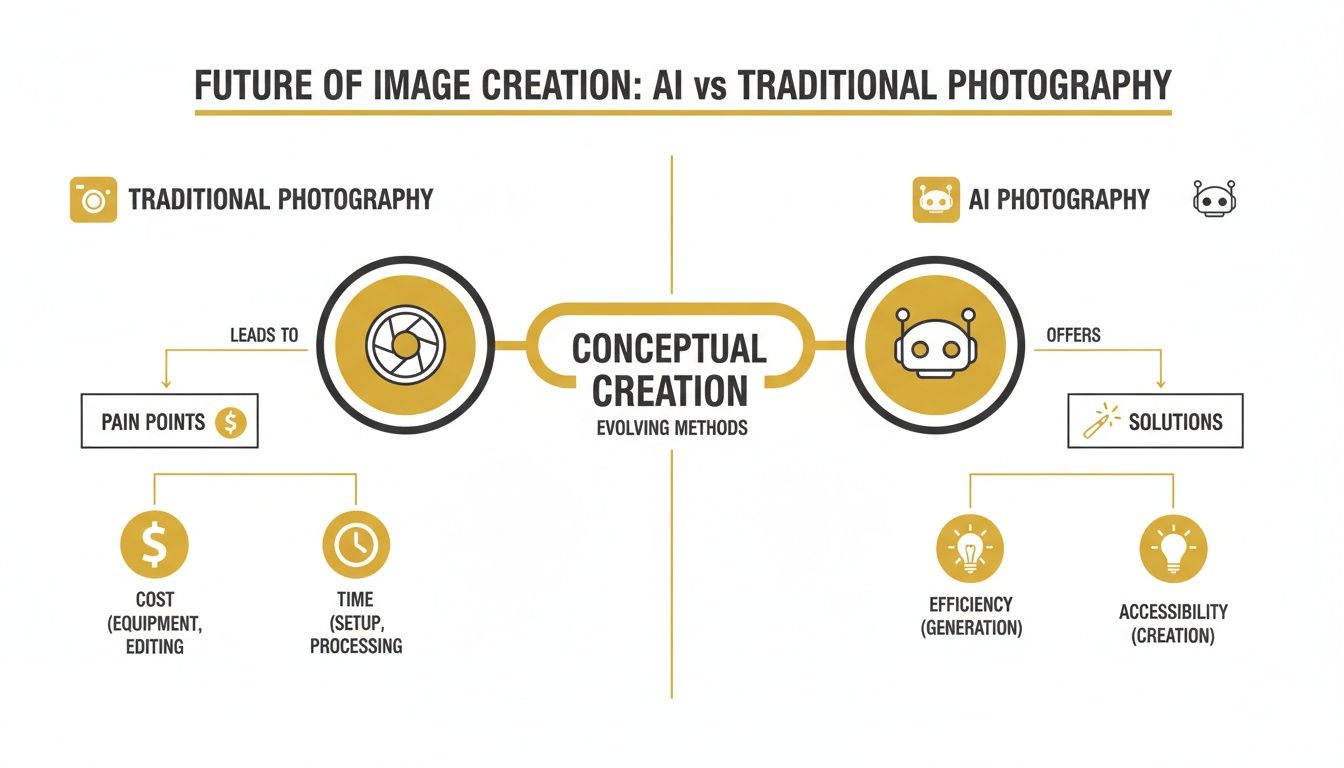
This comparison shows how AI is flipping the script, swapping out time-consuming and expensive processes for efficient, accessible digital alternatives.
Practical AI Techniques in Action
AI isn't just about creating brand-new images. Its deep understanding of what makes a good photo allows it to perform incredibly useful tasks that solve everyday problems for creators and businesses.
Generative AI has obliterated traditional photography timelines, producing 15 billion images since 2022—a staggering feat that took conventional cameras roughly 149 years to match. Today, 34 million AI-generated images burst into existence daily, with 80% powered by open-source models. You can discover more insights about the rapid growth of AI photo creation and its impact on the market.
This mind-boggling scale is driven by a whole toolkit of specialized AI techniques. Let’s break down a few of the most important ones.
To help clarify these concepts, the table below summarizes the core AI technologies and how they're used in modern photography workflows.
Key AI Photography Techniques Explained
| AI Technique | How It Works (Simple Analogy) | Practical Application (Example) |
|---|---|---|
| Smart Enhancement | It's like having a professional photo editor who instantly spots and fixes imperfections. | Automatically removing skin blemishes in a portrait, adjusting poor exposure, and sharpening blurry details with a single click. |
| Intelligent Relighting | Imagine being able to move the sun or add studio lights after a photo has already been taken. | Turning a flatly lit product shot into a dramatic, eye-catching image by adding a new, realistic light source from the side. |
| AI Upscaling | Think of an artist meticulously recreating a tiny photo on a giant canvas, filling in the missing details perfectly. | Taking a small, low-resolution logo and enlarging it for a billboard without it becoming pixelated or blurry. |
These techniques are just the beginning. They represent a fundamental shift in how we can edit, improve, and create visual content, making professional-grade results accessible to everyone.
How AI Transforms Creative Workflows
The real magic of AI for photography isn’t just about making a single, cool image. It’s about completely overhauling the way we produce visuals, turning the old, slow process of concept-shoot-edit into a lightning-fast, creative loop.
Think of it like having a personal photographer on call 24/7—one who never gets tired and can perfectly nail any style or concept you throw at them. That’s what modern AI platforms bring to the table. They’re not just speeding things up; they’re fundamentally changing how individual creators and big brands get things done, compressing weeks of work into a few hours.
A New Playbook for Content Creators
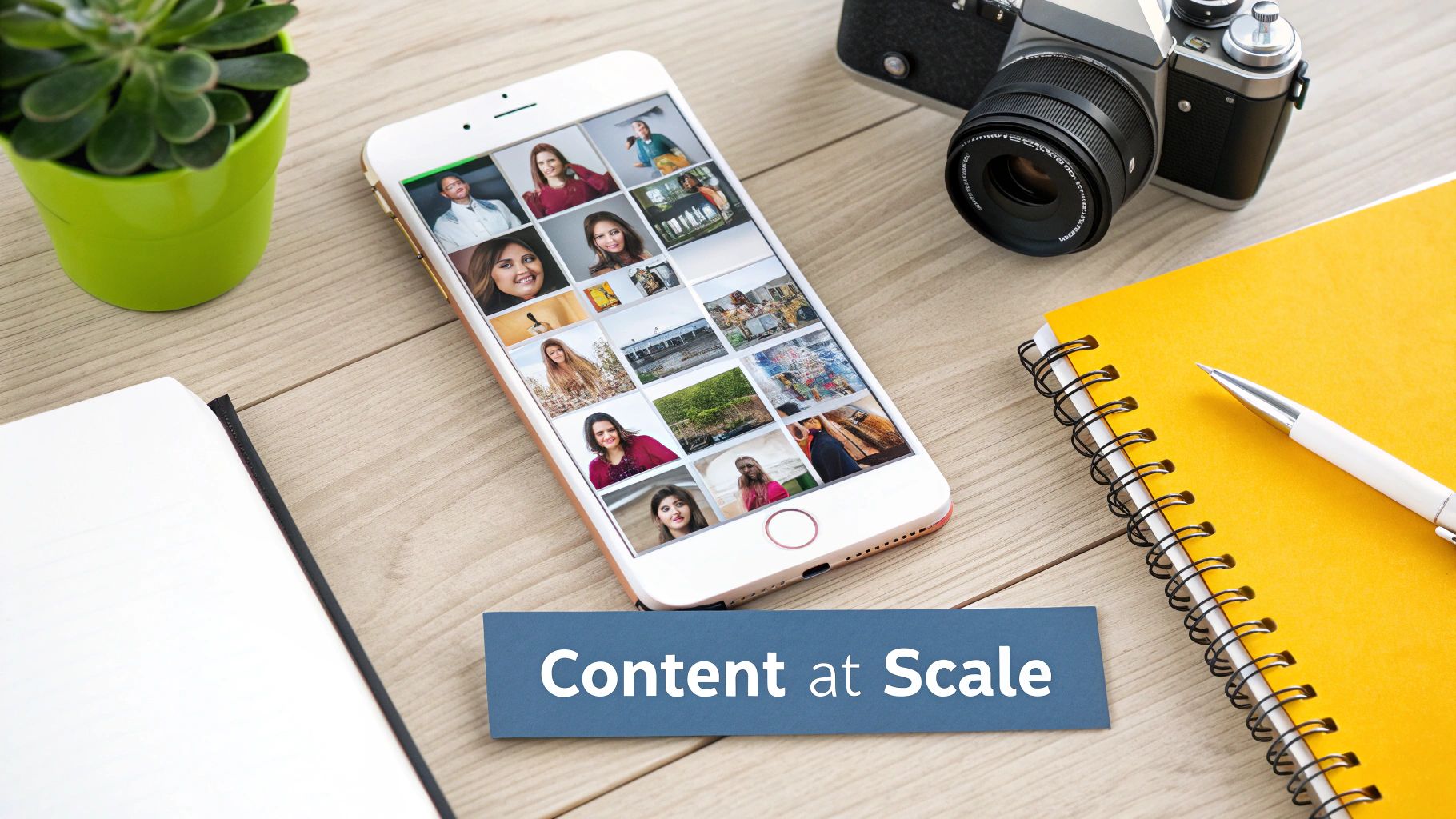
If you’re an influencer or social media manager, you know the content treadmill never stops. Trying to fill a calendar for Instagram or TikTok with fresh, high-quality images usually means a chaotic mess of photoshoots, outfit changes, and location scouting. AI offers a much smarter way.
Here’s what that new workflow actually looks like:
- Start with a Few Good Photos: You just upload a handful of your best headshots. The AI learns your face, creating a consistent digital version of you.
- Describe What You Need: From there, you just tell it what you want. It could be a simple "professional headshot in a modern office" or something more specific, like "candid lifestyle shot, laughing in a Parisian café, golden hour lighting."
- Generate in Bulk: Instead of one photo at a time, you can generate dozens of on-brand visuals at once. The AI drops your digital likeness into countless scenes, outfits, and poses, giving you a huge variety of unique but consistently "you" images.
Suddenly, a single creator can knock out an entire month's worth of content in an afternoon without ever leaving their desk. All that time saved can go back into strategy and engaging with your audience. The trick is using AI that produces realistic AI photos that people instantly recognize as you.
The core shift is from capturing moments to creating them on demand. AI allows creators to build a visual library that perfectly matches their personal brand or campaign aesthetic without the time and cost of physical photoshoots.
This ability to generate endless variations also lets you A/B test different visual styles on the fly, quickly discovering what your audience loves and staying ahead of trends.
Streamlining Ecommerce and Product Photography
For any ecommerce brand, product photos are the lifeblood. They build trust, drive engagement, and are often the final nudge that turns a browser into a buyer. But getting those photos is a huge operational headache—juggling inventory, casting models, renting studios, and waiting on post-production.
AI photography completely demolishes that old model. Brands can now create incredible, professional product photos without a physical item, a model, or a camera ever needing to be in the same room.
Here’s how an apparel brand might use it:
- Product Shots: Take one clean photo of a shirt on a mannequin. The AI can then place that shirt on a diverse range of AI-generated models, showing shoppers how it fits on different body types.
- Virtual Try-Ons: Let customers see how an item looks on a model that resembles them. This is a game-changer for boosting confidence and slashing return rates, which can be a massive drain on profits. Some studies show this can bump conversion rates by as much as 30%.
- Lifestyle Campaigns: A brand can generate an entire marketing campaign showcasing its products in countless settings—from edgy urban street style to peaceful nature scenes—without a single expensive location shoot.
This workflow drastically cuts production costs and gets products to market faster. A new clothing line can have a full set of stunning promotional images ready for its website and social media the very same day the designs are finalized. That’s a massive competitive edge.
Powerful Business Applications for AI Photography
Beyond the creative perks for individual photographers, AI is becoming a serious strategic asset for businesses. This is where AI stops being just a neat tool and starts driving real-world efficiency, slashing costs, and opening up entirely new ways to grow. For companies ready to jump in, AI offers a massive advantage in today's crowded market.
The numbers tell the story. The global AI photography market is on a tear, rocketing from USD 2.85 billion to a projected USD 8.95 billion by 2033. That’s fueled by a steady 13.6% annual growth rate. This isn't just hype; it's driven by real results, like professional photographers reporting their editing workflows are now 40-50% faster. DataHorizzon has the full research if you want to dig into the market drivers.
Scaling Marketing and Social Content
Let’s be honest, the demand for fresh marketing content is a monster that never sleeps. Traditional photoshoots are slow and expensive, making it nearly impossible to keep up with the breakneck speed of social media. This is where AI photography steps in as a game-changer, letting teams generate an entire campaign’s worth of visuals almost overnight.
Think about a new product launch. Instead of one costly photoshoot, a brand can now use AI to:
- Generate Endless Campaign Visuals: Create hundreds of images showing the product in different scenes, with different models, and in various styles perfect for Instagram, TikTok, or Facebook ads.
- A/B Test Ad Creatives: Quickly spin up dozens of visual variations for ad campaigns. This lets you test what actually resonates with your audience, making your ad spend smarter and driving up conversions.
- Keep Everything On-Brand: Ensure every single image—from a quick social post to a major website banner—perfectly matches your brand’s look, color palette, and feel.
This flips marketing from a reactive scramble to a proactive strategy. Teams can experiment and fine-tune their visuals at a pace that was just a dream a few years ago.
Revolutionizing Ecommerce with Virtual Try-Ons
One of the biggest hurdles in online retail is that customers can't physically touch or try on products. AI-powered virtual try-on technology tackles this problem head-on, creating a far more engaging and confident shopping experience, especially for fashion and beauty.
A shopper can simply upload a photo and instantly see how a dress fits or how a new lipstick shade looks on them. The business benefits are huge. Major e-commerce brands have found that adding virtual try-ons can bump conversion rates by as much as 25-30%. It not only helps customers choose the right product but also dramatically cuts down on expensive returns.
AI photography is turning static product pages into dynamic, personalized experiences. This builds a real connection with customers and gives them the trust they need to click "buy."
Pre-Visualization for Video and Film
AI's impact isn't limited to still images; it's also making waves in video and film production. Directors and producers are now using image-to-video AI to make the pre-production process smoother and more intuitive. They can feed the AI concept art or storyboards and get back short, cinematic clips.
This offers a few key advantages:
- See Scenes Come to Life: Directors get a real feel for a scene's pacing, camera angles, and mood long before the cameras ever roll.
- Improve Team Collaboration: It's much easier to share a creative vision with the entire crew—from cinematographers to set designers—when you have an animated storyboard to show them.
- Save Time and Money: Catching potential problems during pre-visualization is infinitely cheaper than trying to fix them on a busy set.
By using AI to bridge the gap between a static idea and the final video, creative teams can iron out the kinks early. This leads to a much more efficient production pipeline from start to finish. If this is an area that interests you, you should check out our guide on the best AI photo generator tools that are making these new workflows possible.
Navigating Ethics and Best Practices in AI Imagery
As AI for photography moves from a novelty to a standard part of the creative toolkit, it opens up a whole new conversation around ethics, rights, and just plain responsible use. This tech is incredibly powerful, but that power demands we handle it with care and integrity.
Figuring this stuff out isn’t just about dodging legal trouble; it's about building trust with your audience and making sure your creative work is built on a solid foundation. The debates happening right now cover everything from personal privacy to the very definition of what art is. We're talking about the data used to train AI models, how we label synthetic images, and the big one: who actually owns an AI-generated picture.
Understanding Likeness and Consent
Right out of the gate, the most pressing ethical issue is using someone's likeness. Creating a synthetic image of a real person without their explicit permission is a serious ethical misstep. This is particularly critical with "digital twin" technology, where AI can generate a photorealistic, controllable model of an individual.
Responsible AI platforms are built on the bedrock of consent. The best practice is straightforward: only use images of yourself or individuals who have given you clear, informed permission to create an AI version of them. This is your best defense legally, and more importantly, it respects a person’s fundamental right to their own image. It's also why tools designed to create a consistent digital version of you are often a much safer starting point for creators and brands.
Using AI responsibly starts with a foundation of consent. Your creative freedom should never come at the expense of someone else's rights to their own image and identity.
Stick to this principle, and you can create with confidence, knowing you aren't crossing into a legal or ethical gray zone.
The Evolving World of AI Copyright
So, who owns a picture an AI makes? That question is kicking up some serious dust in courtrooms and legal circles all over the world. The law is still playing catch-up, but a few key ideas are starting to solidify.
In many places, including the United States, copyright has always been about protecting works created by a human author. Since AI-generated images aren't currently seen as having a human author in the traditional sense, they often don't qualify for the same copyright protections you'd get with a photograph you took yourself.
What does this mean for you in practice?
- Read the Fine Print: Your most important document is the terms of service for the AI tool you're using. Reputable platforms will grant you a license—usually a commercial one if you're on a paid plan—that spells out exactly how you can use the images you create.
- The Human Touch Matters: The more of your own creative work you pour into an AI image after it's generated—think significant editing, compositing, and manipulation—the stronger your potential claim to authorship becomes.
- Keep Your Ear to the Ground: This area of law is changing fast. It's smart to pay attention to new rulings and guidelines to make sure your workflow stays on the right side of the law.
Best Practices for Responsible AI Use
To navigate this new territory well, it all boils down to a few core habits. If you make these part of your process, you can use AI for photography tools ethically and with great results.
- Be Transparent with Your Audience: If an image is AI-generated, just say so. Being upfront builds trust and helps people appreciate the cool new ways you're creating content.
- Verify Your Commercial Rights: Before you use an AI image for anything business-related, triple-check that your license or subscription plan with the service gives you the green light for commercial use.
- Put Consent First, Always: Never, ever create synthetic images of identifiable people unless they've given you their direct and enthusiastic permission. This is the golden rule.
- Create, Don't Deceive: Use these amazing tools to inspire and build, not to mislead people, spread misinformation, or perpetuate harmful stereotypes.
By making these practices your default, you can dive into the incredible creative potential of AI and still hold your head high, knowing you're doing it the right way.
Where Do We Go From Here?
If there’s one thing to take away from this guide, it’s this: AI in photography isn't some far-off concept threatening to replace artists. It’s a powerful new set of brushes in your toolkit, ready to amplify your creative spark. These tools are breaking down the old walls of cost, time, and technical skill, effectively putting an entire production studio at your fingertips.
The real shift isn't about AI taking over; it's about what it empowers you to do. The technology is moving fast. Just look at the market for computational photography—the engine behind these tools—which jumped from $15.20 billion to an expected $17.40 billion in a single year. You can dig into the full market report to see just how quickly this space is evolving. This is the tech that lets you generate everything from polished product shots to eye-catching social media posts on the fly.
Your Next Big Idea is Closer Than You Think
The biggest opportunity right now is to just dive in. Start experimenting. See how these tools can completely reshape your workflow. What used to demand weeks of meticulous planning, shooting, and post-production can now be achieved in a matter of hours. This isn’t just about speed; it's about freeing you up to focus on what really matters: your story, your brand, and your unique creative voice.
The change is fundamental: we're moving from capturing moments to creating them entirely on demand. AI acts as a direct bridge from your imagination to a finished visual, making abstract ideas tangible in an instant.
Whether you're crafting stunning portraits, perfecting product imagery, or even venturing into video, your next masterpiece is truly just a few clicks away. And if you're curious about adding motion to your work, check out our guide on how to make AI videos. The creative runway is wide open, and the tools have never been more ready for you to take flight.
Frequently Asked Questions About AI in Photography
Stepping into AI-powered photography can bring up a lot of questions. How does it work in the real world? Is it legal? Let's break down some of the most common queries so you can move forward with confidence.
Can I Actually Use AI-Generated Photos for My Business?
Yes, but you have to be smart about it. The key lies in the terms of service of the AI platform you're using. Most reputable tools offer commercial licenses, usually bundled with their paid subscriptions, which give you the green light to use the images for marketing, ads, and sales. Always, always read the fine print first.
A much safer bet for business use comes from platforms like PhotoMaxi, which create new, synthetic models based on your images. This route neatly sidesteps the thorny legal and ethical issues that come with using someone else’s likeness, giving you a solid, worry-free foundation for your commercial projects.
Is AI Going to Put Photographers Out of Business?
It's far more likely to become their new favorite tool. Think of AI as an incredibly powerful assistant, not a replacement. It's brilliant at handling the tedious, time-consuming parts of the job—intricate edits, tedious background removals, or creating dozens of shot variations. This frees up photographers to do what they do best: focus on creative direction, storytelling, and building a connection with their subject.
AI handles the grunt work. It automates the technical tasks, which lets photographers pour more energy into their artistic vision and create even more compelling work for their clients.
Sure, AI is fantastic for churning out high volumes of content, like product shots for an e-commerce store. But for capturing authentic human moments and bringing a unique artistic eye to a project? Professional photographers aren't going anywhere. Technology complements that skill; it doesn't make it obsolete.
How Can I Get AI Models to Look the Same in Every Shot?
Ah, the consistency problem. This is a classic frustration with many basic AI image generators—you get a slightly different face in every single render. The solution is to use a tool that was specifically designed to fix this.
Advanced AI for photography platforms solve this by first creating a detailed 'digital twin' of a person from a handful of initial photos. Once that digital model is locked in, you can drop it into any scene, outfit, or pose you can imagine, and the face and features will remain identical every time. This is how you get visuals that look consistent and on-brand across an entire campaign.
For any creator or business trying to build a recognizable identity, that kind of consistency isn't just a nice-to-have; it's essential.
Is This AI Stuff Hard to Learn?
Not anymore. The best modern platforms are built for everyone, from total beginners to seasoned pros. You don't need to be a coding wizard or a Photoshop master. In most cases, you can get incredible results just by typing simple descriptions or clicking a few buttons.
The process usually looks something like this:
- Upload a starting photo: This could be a picture of you, a teammate, or a product.
- Describe what you want: Use plain English to explain the scene, style, or action.
- Generate and tweak: The AI creates the images, and you can then refine them with more instructions.
This ease of use is a huge part of why AI for photography is taking off. It flattens the steep learning curve that used to come with creating professional-level images, opening up a whole new world of creative potential for anyone with an idea.
Ready to stop imagining and start creating? With PhotoMaxi, you can generate a consistent, monetizable AI version of yourself and produce limitless studio-quality photos and videos in minutes. Transform your creative workflow and bring your boldest ideas to life today at https://photomaxi.com.
Related Articles


Ready to Create Amazing AI Photos?
Join thousands of creators using PhotoMaxi to generate stunning AI-powered images and videos.
Get Started Free