
Ai Product Photography: Transform Ecommerce Visuals with AI (ai product photography)
So, what exactly is AI product photography? Put simply, it’s a way to create stunning, lifelike product images without ever stepping foot in a studio. You start with a basic photo of your product, and artificial intelligence does the rest, generating a virtually endless supply of creative scenes and backdrops.
The New Era of Product Visuals
If you've ever winced at an invoice from a traditional photoshoot, you know the feeling. The whole process has always been a massive drain on time, money, and creative energy. For years, that was just the cost of doing business, but that entire model is being turned on its head.
Think of the old way like commissioning a painter. It was a slow, expensive ordeal, and once the painting was done, that was it. You were stuck with the final piece, whether you loved it or not.
A Fundamental Shift in Visual Creation
AI product photography, by contrast, is like having a creative genius on your team who can dream up and deliver infinite visual concepts in a matter of seconds. It's a completely new way of thinking about and producing visual content. This isn't just some passing trend; it’s becoming the new standard for how brands create powerful imagery with incredible speed and flexibility.
This technology opens doors for everyone, from a one-person Shopify store to a massive marketing department. It puts professional-grade visuals within reach without the usual hurdles of sky-high costs and logistical nightmares. The freedom to generate visuals on-demand changes the game. If you want to dig deeper, our guide on how businesses are using AI for photography offers more insight into gaining a competitive edge.
The Power of Instant Iteration
The real magic here is the ability to test, learn, and pivot in an instant. Instead of trying to guess which lifestyle shot will connect with your customers, you can generate a dozen versions and let the actual data tell you what works.
This approach gives brands the power to:
- Launch Campaigns Faster: Whip up visuals for a holiday sale or a new promotion in minutes, not weeks.
- Personalize Marketing: Create specific images that speak directly to different customer groups or social media platforms.
- Reduce Financial Risk: Try out bold, creative concepts without having to bet the farm on a single, expensive shoot.
By breaking free from the limits of a physical photoshoot, you open up a whole new world of creative potential. This is about more than just saving money—it’s about making your brand more agile, responsive, and visually exciting than ever before.
How AI Product Photography Actually Works
Jumping into AI product photography can feel a bit like trying to figure out a magician's secret. It looks like pure wizardry from the outside, but once you pull back the curtain, the process is actually quite logical. The key takeaway is that this technology isn't here to replace your creative input; it’s a new tool that partners with you to execute your vision.
It all starts with a single, clean photo of your product. You don't need a fancy lifestyle setup—just a straightforward shot of the item, usually against a simple, neutral background. This one image becomes the foundation, the AI’s single source of truth about your product.
Next, the AI gets to work, meticulously analyzing every pixel of that photo. It learns the product’s exact shape, texture, color, and even how light hits its surfaces. This is the crucial step that makes dedicated product photography tools so different from your average AI image generator. The aim isn't to guess what your product looks like, but to understand it perfectly so it can be dropped into a new scene without looking out of place.
The Creative Collaboration with AI
Once the AI has a perfect digital model of your item, the real fun begins. This is where you take the reins as the creative director. You guide the AI by writing simple text prompts—just plain English—to describe the exact scene you have in mind.
Think of it like you're briefing a set designer and photographer all at once. You might type in a prompt like:
- "A skincare bottle on a minimalist marble vanity next to a white orchid."
- "A pair of hiking boots on a mossy rock with a misty mountain in the background."
- "A coffee mug on a rustic wooden table, with steam rising and scattered coffee beans."
The AI combines your instructions with its detailed understanding of your product to generate a completely new, photorealistic image. It’s smart enough to add natural shadows, reflections, and lighting, making your product look like it was physically present in that custom scene all along. For a deeper dive into this, check out our guide on using a photorealistic AI image generator.
Maintaining Product Authenticity
One of the biggest concerns with AI is whether the final image will be true to the actual product. And that’s a valid worry. Generic AI tools can sometimes get creative, slightly altering a logo, tweaking a color, or warping a product’s shape. In e-commerce, that’s a deal-breaker. Customer trust is built on accuracy.
The core principle is simple but powerful: the AI builds a new world around your product, but it never changes the product itself. Your item remains the hero of the shot, perfectly preserved in every detail.
This is why specialized platforms like PhotoMaxi are built differently. They are engineered to prioritize product fidelity, using models specifically trained to keep the source product 100% intact while generating the background. Your customers see an exact representation of what they’re buying, just placed in a compelling context that makes them want to click "add to cart."
The market's explosive growth speaks for itself. The AI product photography space is expected to rocket from $450 million to a projected $5 billion by 2035, which tells you just how valuable this is for brands. That incredible growth is all about the need for high-quality, scalable content in a very crowded e-commerce world. The whole process is designed to be incredibly user-friendly, putting the power to create professional visuals in everyone's hands.
The Business Case for AI Visuals
Let's move past the technical details and get straight to the heart of the matter: why should your business even consider this? Adopting AI product photography isn't just about playing with the latest tech. It's a smart, strategic move that can deliver a serious return on your investment, built on three core advantages that directly boost your bottom line: cost, speed, and creative scale.
For as long as anyone can remember, getting professional product shots meant dealing with a steep, non-negotiable price tag. You had to factor in studio rentals, photographer fees, hiring models, and all the hours spent on post-production. It all adds up, creating a massive hurdle for brands, big and small. AI completely flips that economic model on its head.
Drastically Reducing Production Costs
The financial argument for switching to AI is incredibly strong. A traditional photoshoot can easily run into thousands of dollars for a single campaign, making every final image a significant investment. With AI, that entire cost structure is dismantled, turning a major capital expense into a minor operational one.
The numbers speak for themselves. Recent studies show that businesses using AI for their product visuals are slashing costs by 80-90% compared to the old way of doing things. Think about it: the average cost for one professionally shot photo is around $39. An AI-generated equivalent? It can be done for as little as $0.45. This isn't just a small saving; it's a game-changer that can free up your marketing budget for other critical growth activities.
Accelerating Your Go-To-Market Speed
In today's market, if you're not fast, you're falling behind. Traditional photography is notoriously slow, with projects often dragging on for weeks, sometimes even months. That kind of delay means you might miss a viral trend, react too slowly to a competitor's move, or postpone a product launch simply because you're stuck waiting for photos.
AI photography completely demolishes those old timelines. A task that once required an entire production team weeks to finish can now be handled by a single person in just a few hours.
- Instant Campaign Visuals: Need images for a surprise flash sale or a holiday promotion? You can generate them in minutes, not days.
- Rapid Product Launches: Get your complete set of e-commerce and marketing photos ready to go the same day your product is.
- Real-Time Trend Response: Notice a new aesthetic blowing up on social media? You can create on-brand visuals to jump on the trend immediately.
This kind of agility allows your brand to move at the speed of the market, not the speed of a photo studio. To see how this can fit into your existing process, check out our guide on AI tools for marketing teams.
Traditional Photography vs AI Product Photography A Head-to-Head Comparison
To put these differences into perspective, let's directly compare the old-school approach with the new AI-powered workflow. This table breaks down the key metrics, showing just how much more efficient modern tools can be.
| Metric | Traditional Photography | AI Product Photography |
|---|---|---|
| Cost Per Image | $30 - $150+ | $0.45 - $2.00 |
| Turnaround Time | 2-6 weeks | 5-15 minutes |
| Creative Variations | Limited by budget & time | Virtually unlimited |
| Scalability | Expensive and slow to scale | Instantly scalable |
| Team Required | Photographer, stylist, models, editor | One marketing team member |
| Flexibility | Rigid; reshoots are costly | Highly flexible; edits in seconds |
As you can see, the numbers are stark. AI offers a solution that is not only more affordable but also exponentially faster and more flexible, giving you a clear competitive edge.
Achieving Unprecedented Creative Scale
This might be the most powerful benefit of all: the ability to scale your creativity without ballooning your budget. In a traditional setup, every new idea—a different background, a fresh setting, a unique style—demands another expensive photoshoot. This forces brands to play it safe, often ending up with a handful of generic images they hope will appeal to everyone.
AI product photography removes the financial penalty for experimentation. It gives you the freedom to create, test, and optimize an unlimited number of visual concepts to discover what truly drives conversions.
Imagine you want to A/B test ten different lifestyle scenes for a new product on Instagram. With traditional photography, the cost would be astronomical. With AI, it’s not just possible—it’s easy. You can generate dozens of variations tailored to specific audiences, platforms, or ad campaigns. This lets you gather real-world data on which images perform best, so your creative decisions are always backed by results. You can finally stop guessing and start knowing what your customers want to see.
Your Step-By-Step AI Photography Workflow
Alright, let's move from theory to action. Getting started with AI product photography is a lot less intimidating than it sounds. You don’t need to be a tech wizard or a Photoshop pro; the whole process is built for marketers and entrepreneurs who just want incredible images without the fuss.
I'll walk you through the typical workflow using a tool like PhotoMaxi as our example. You'll see how the big-picture benefits—saving money, moving faster, and creating more—play out in a few simple steps.
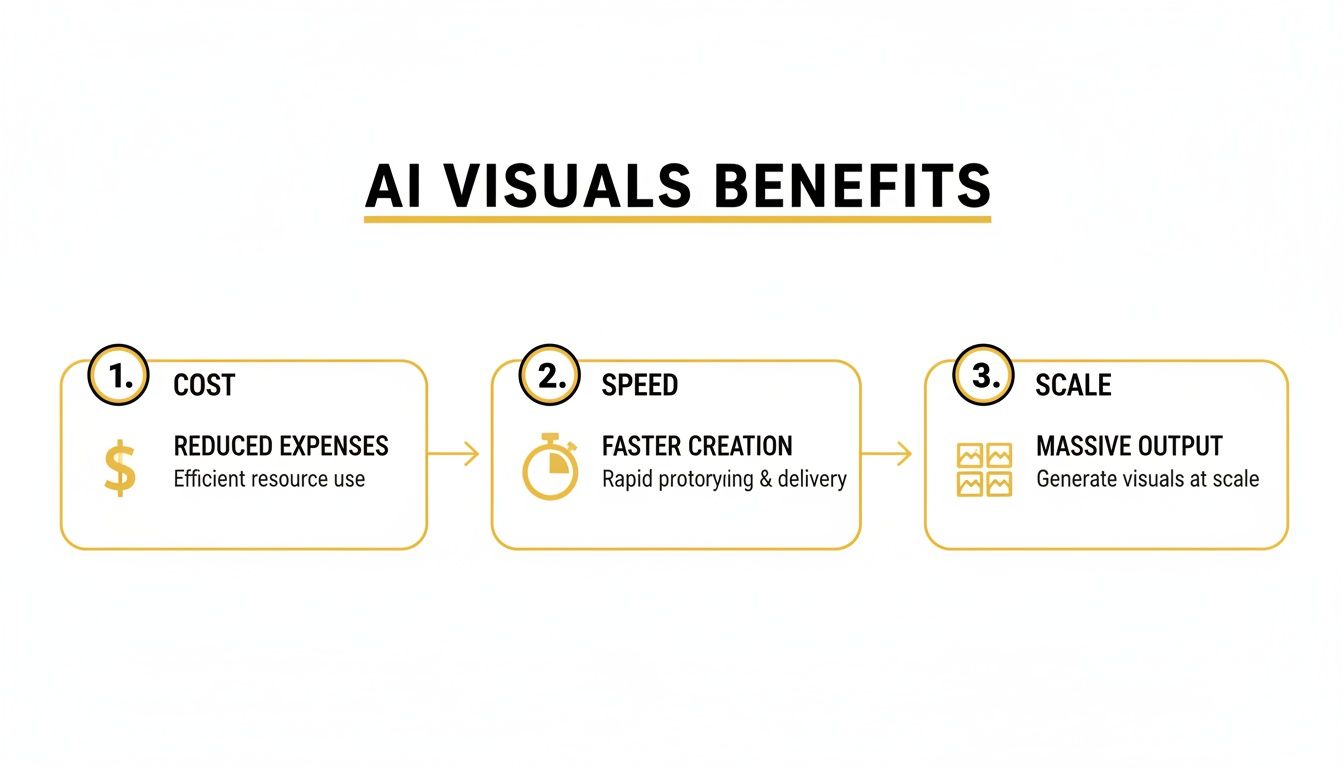
This is the core idea: AI takes the old, expensive photography process and makes it fast, affordable, and incredibly scalable.
Step 1: Capture Your Source Image
Everything begins with a clean photo of your product. This is probably the most critical part of the process because the AI uses this image as its "source of truth." A great source photo is the foundation for a professional-looking final shot.
Here are a few simple tips to get it right:
- Use a Neutral Background: A plain white or light gray backdrop is perfect. It helps the AI cleanly isolate your product without any distracting elements.
- Get the Lighting Right: Soft, even light is your friend. It prevents harsh shadows or bright spots that can look unprofessional. Natural light from a window is often all you need.
- Nail the Angle: A straight-on shot that clearly shows the product's shape, branding, and key details works best.
You really don't need a fancy studio. The camera on a modern smartphone is more than good enough. Snap the picture, and you’re ready to upload it to your AI platform.
Step 2: Write a Powerful Descriptive Prompt
This is where the magic happens. A prompt is just a text description of the scene you want to build around your product. Think of yourself as a creative director telling a photographer exactly what you envision. The more detail you give, the better the AI can execute your vision.
For instance, let’s say you’re shooting a bottle of face serum.
A weak prompt: "On a table."
A strong prompt: "A skincare bottle resting on a minimalist white marble vanity, next to a single fresh orchid and soft morning light coming from a window on the left. Photorealistic, clean aesthetic."
See the difference? The strong prompt paints a complete picture with materials, surrounding objects, lighting, and a specific mood. This gives the AI clear instructions to create something that feels intentional and on-brand.
Step 3: Generate and Iterate on Concepts
Once you hit "generate," the AI will spit out several image options in seconds. This is where you can experiment freely. The first result is just a starting point, not the final destination.
Here's how to refine your ideas:
- Tweak the Prompt: Make small adjustments to your text. Maybe add "with a dramatic shadow" or swap "marble vanity" for "rustic wooden surface."
- Explore Different Styles: Create bright, punchy scenes for your Instagram feed and then generate a few sophisticated, moody shots for your website’s homepage.
- A/B Test Visuals: Why guess what works? Create a handful of different concepts and test them with your audience to see which images drive more clicks and conversions.
This rapid-fire iteration costs you nothing more than a few minutes of your time. Compare that to the cost and headache of booking an entirely new photoshoot just to try a different background.
Step 4: Refine and Finalize Your Images
When you’ve landed on a concept you love, it’s time to add the finishing touches. Most dedicated AI product photography tools have built-in editors, so you don’t even have to open another program.
- Upscaling: Instantly increase the image resolution so it looks crisp and sharp on large website banners or even in print.
- Relighting: Fine-tune the lighting to highlight a specific feature or enhance the overall mood. You can shift the light source or make it softer or brighter.
- Minor Edits: Some platforms let you do quick touch-ups, like removing a small imperfection or cleaning up the background.
With your image perfected, the last step is getting it in front of your customers. Many tools, PhotoMaxi included, connect directly with e-commerce platforms like Shopify. This means you can push your new, high-converting visuals straight to your product listings in just a couple of clicks, closing the loop from creation to publication with incredible efficiency.
Real-World Examples of AI Driving Ecommerce Success
Seeing the workflow is one thing, but witnessing the real-world impact is what truly shows the power of AI product photography. Theory and step-by-step guides are great, but the stories of actual brands using this tech to grow their business are what make the benefits click. Let's look at how two very different companies used AI-generated visuals to solve unique challenges and get some impressive results.
These examples go beyond abstract ideas to show how businesses are actively boosting sales, engagement, and brand perception just by rethinking their visual strategy.
Case Study: The Small Jewelry Brand’s Big Campaign
Our first story is about a small, independent jewelry brand running on Shopify. Like a lot of startups, their biggest hurdle was creating high-end lifestyle images that could compete with established players, all without a five-figure marketing budget. They needed a full campaign to launch a new collection, complete with models and exotic locations, but the cost was a non-starter.
Instead of settling for plain product-on-white shots, they turned to AI.
The Challenge: The brand needed a diverse set of lifestyle photos featuring their necklaces and earrings in aspirational settings—think a Parisian café, a sun-drenched beach, and an elegant evening event. A traditional shoot would have meant hiring multiple models, scouting locations, and coordinating travel, easily costing tens of thousands of dollars.
The AI Solution: Using a platform like PhotoMaxi, they started with clean, simple photos of their jewelry. From there, they used detailed prompts to generate entire scenes around each piece, essentially building a stunning lifestyle campaign from scratch. They could dial in everything from the model's outfit to the time of day, producing dozens of unique, on-brand images in just a few hours.
The Measurable Results: The impact was immediate and striking. After updating their product pages and running social media ads with the new AI visuals, the brand saw a 28% increase in their conversion rate over the next month. Customer engagement on Instagram also shot up, with post interactions jumping by over 60%—the images finally told the compelling story their jewelry deserved.
This case really drives home a key point: AI product photography levels the playing field. It gives small businesses the power to produce world-class visual campaigns that were once only possible for giant corporations.
Case Study: The Beverage Company’s Hyper-Targeted Ads
Next, let's look at a much larger company—a well-known beverage brand prepping for a major seasonal push. Their goal was to create hyper-targeted ad campaigns for different customer segments across various regions. They needed visuals for a summer barbecue, a cozy autumn setting, and a festive holiday party, and each one had to feel authentic to different demographics.
The sheer volume and variety of images required would have been a logistical nightmare to shoot traditionally. It's no secret that high-quality visuals directly impact sales; in fact, great images have been shown to boost conversion rates by up to 33% on e-commerce sites. You can discover more about how AI images drive sales on photoroom.com.
Facing this massive creative demand, the brand's marketing team used AI to rapidly produce all the assets they needed. They generated dozens of variations for each theme, swapping backgrounds, props, and moods to perfectly align with each target audience. This let them run highly specific, localized ad campaigns without the massive overhead, leading to a significant lift in ad performance and a much smarter use of their marketing budget.
Where Do We Go From Here? Securing Your Brand's Future with AI Visuals
As we've laid out, AI product photography isn't some far-off idea anymore. It's here, and it's already a core part of a smart marketing strategy. Brands that are moving past the slow, expensive, and inflexible world of traditional photoshoots are gaining a serious competitive advantage.
This isn't just a slight improvement over the old way of doing things; it's a complete reimagining of how we create visual content. The benefits are clear and powerful: huge cost reductions, getting products to market faster, and a creative ceiling that's higher than we ever thought possible. Jumping on this now isn't about just keeping pace—it's about leading the pack.
It's a Strategic Investment, Not Just a Tech Upgrade
The real power here is how nimble and responsive this technology makes your brand. You're no longer stuck with the handful of shots from one expensive photoshoot. Instead, you have the freedom to experiment. This is your chance to test different visual styles, learn from real customer data, and fine-tune your imagery to make sure every picture is pulling its weight and boosting your sales.
Think of adopting AI for your visuals less as a tech update and more as a strategic investment in your brand's future. You're unlocking the kind of agility and creativity that will separate the winners from the losers in the next era of e-commerce.
It's like having the ultimate creative playground. Need visuals for a flash sale? A new social media campaign? A specific holiday? You can generate them on the fly, for any platform or audience, without blowing your budget. This is how you build a brand that stays fresh, relevant, and visually exciting no matter where a customer sees it.
Your Next Move in AI-Powered Creativity
Getting started with AI visuals has never been easier. A straightforward tool like PhotoMaxi gives you the perfect entry point to explore what’s possible, without needing a degree in computer science or a massive budget. You can start creating studio-quality images that make your brand look incredible and truly resonate with your audience, right now.
So, the only real question is, what will you create first? By taking that initial step, you’re not just making better product shots. You’re building a brand that's more adaptable, more creative, and ultimately, more profitable for years to come.
Common Questions About AI Product Photography
Dipping your toes into any new technology always brings up a few questions. It’s totally normal to wonder about the practical side of things, from legal rights to whether the images will even look good. Let's tackle some of the most common uncertainties about AI product photography so you can move forward with confidence.
Once we clear these up, you'll see just how powerful and easy to use these new tools really are.
Are AI-Generated Product Photos Legal for Commercial Use?
Yes, they are—as long as you’re using a service built specifically for commercial work. Reputable platforms like PhotoMaxi build their tools on licensed or proprietary AI models. When you create an image with them, you're granted a commercial license for that final picture.
This means you can use your AI-generated visuals pretty much everywhere you need to, including:
- Your website’s product pages and hero banners
- Social media campaigns on Instagram, Facebook, and TikTok
- Digital ads and email marketing
- Even printed materials like flyers or catalogs
It's always a good habit to quickly check the terms of service of any AI tool you use. That simple step ensures you have the rights you need for your marketing plans, saving you from any legal headaches down the line.
Will AI-Generated Images Look Realistic and On-Brand?
They absolutely can. The realism of today’s AI models is pretty staggering; they often produce images that are impossible to tell apart from a traditional photoshoot. Getting a result that feels both authentic and aligned with your brand really boils down to two things.
First, you need a clean, well-lit photo of your actual product to start with. The AI needs good information to work with. Second, writing clear, descriptive prompts is how you steer the AI toward the exact style and mood you’re after.
Think of it this way: the AI is an incredibly skilled photographer, but you are the creative director. Your input directly shapes the final shot, making sure it fits your brand’s unique vibe, whether that’s clean and minimalist or rich and dramatic.
How Much Technical Skill Is Needed for AI Photography Tools?
This is the best part: you need almost no technical skill. The top AI product photography tools are built for marketers and entrepreneurs, not AI engineers. The whole experience is designed to be intuitive.
You just upload your photo, describe the scene you want in plain English, and the software does all the heavy lifting. You can generate a whole portfolio of professional, studio-quality images in a matter of minutes, without knowing the first thing about photography, lighting, or photo editing.
Can AI Handle Products with Reflections or Transparency?
This used to be a huge challenge for older AI models, but the technology has come a long way. Today’s more advanced platforms are much better at rendering tricky materials like glass, shiny metal, liquids, and other see-through or reflective surfaces.
The key is still to start with a crisp, high-resolution source photo that clearly captures these properties. You can also give the AI a little nudge in your prompt by getting specific. For instance, adding phrases like "glossy reflections on the chrome surface" or "clear glass bottle showing the whiskey inside" helps the model understand exactly what you want it to create, leading to a much more believable result.
Ready to stop wondering and start creating? With PhotoMaxi, you can generate stunning, on-brand product visuals in minutes, not weeks. Try PhotoMaxi today and see the future of product photography for yourself.
Related Articles


Ready to Create Amazing AI Photos?
Join thousands of creators using PhotoMaxi to generate stunning AI-powered images and videos.
Get Started Free